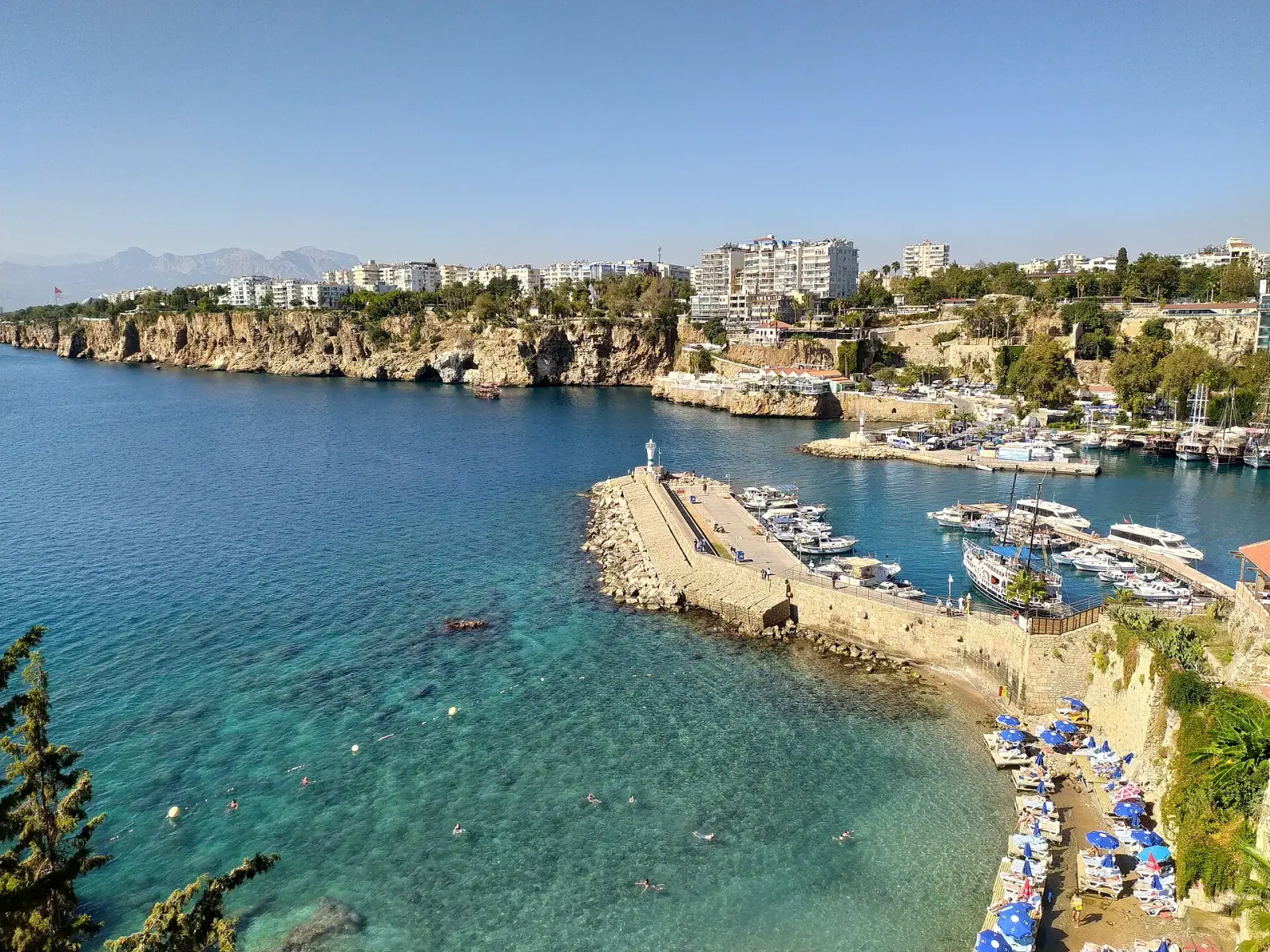

Sixty days. That is how long you have to take a refused residence permit to the administrative court in Turkey, counted from the day the decision is served on you, and if it comes with a deportation order you have seven. Suppose the refusal of your renewal reaches you in October, when afternoons in Antalya still reach about 28°C, the pebbles of Konyaaltı beach are emptying of holidaymakers and the Beydağları range stands sharp across the bay.
That is the day a lawyer in Antalya earns the fee, and it comes less often than the city's many English-speaking law offices suggest. You can file the permit yourself: the e-İkamet appointment is free, and the migration authority's own checklist tells you to ignore anyone who charges for one. You need a lawyer in three situations: when the state says no, when serious money changes hands at the land registry, and when company law demands one. Everything else is paperwork you can carry yourself.
There is so much paperwork because so many people want to stay. Antalya drew more than 16.5 million foreign visitors in 2023, about 120,000 foreigners live in the city itself, and Britain and Germany both keep consulates here. The pull is easy to see: nearly 3,000 hours of sunshine a year, the old Roman harbour at the foot of Kaleiçi, a 13-kilometre beach on the western side of the city and the long sands of Lara on the eastern side. Staying on, buying or trading all run through Turkish offices, in Turkish.
| Challenge a permit refusal or cancellation | 60 days |
|---|---|
| Challenge a deportation decision | 7 days |
| Income for a tourism-ground permit, one person | about $863 a month |
| Home value for a homeowner permit | $200,000 |
| Residence permit card | $20 |
| Office consultation, first hour | $82, then $37 an hour |
| Written legal opinion, first hour | $143 |
| Administrative court case | $615, or $820 with a hearing |
| Title transfer or registration work | $246 |
| Company formation or citizenship file | $1,230 |
| Title deed fee on a purchase | 2% buyer, 2% seller |
| Property value for citizenship | $400,000 |
| Work permit, up to one year | $258 |
Lawyer fees are the minimums in the bar's 2025 to 2026 tariff: a lawyer may charge more, never less. Prices are in US dollars at the Central Bank of Türkiye's exchange rate of 48.79 lira to the dollar on 25 September 2026.
What you can file without a lawyer
Most remote workers who stay past their visa-free days hold a short-term residence permit, granted for up to two years at a time on grounds that include tourism, owning a home and setting up business connections. You apply online at e-İkamet, then bring the paper file to the Antalya Provincial Directorate of Migration Management on your appointment day. You sign the form yourself, so at this stage a lawyer adds convenience and nothing else.
The file is short but exacting. The migration authority's document list asks for the form, your passport, biometric photos, fee receipts, health insurance for the whole permit period, proof of means and proof of address. For a rented flat, the address proof is a notarised copy of the lease naming the landlord, so the lease has to be signed at a notary, not over a café table.
On the tourism ground, one person must show income of at least one and a half times the net minimum wage, about $863 a month, over at least the last three months; a family applying together needs one minimum wage per person. As a homeowner, the flat must have been worth $200,000 when you bought it, and you may not rent it out. Whichever ground you use, the checklist says it plainly: a residence permit does not give you the right to work in Türkiye.
The fees are small. The card costs $20 for everyone, while the permit fee depends on your passport, because it is set by reciprocity: the default rate is about $46 for each month after the first, and citizens of ten countries, among them Ireland, Denmark and Czechia, pay none. Once a first permit is approved, you have 20 working days to register your address.
Where you sign the lease matters as much as what you sign. The directorate publishes a list of neighbourhoods closed to new residence registrations, and three are in the beach district of Konyaaltı: Liman, Hurma and Sarısu, where the cable car starts its 15-minute climb to the revolving restaurant on Tünek Tepe, 618 metres above the bay. The list also names Topçular in Muratpaşa and two industrial-zone neighbourhoods in Döşemealtı.
In Alanya, the list still names Kargıcak, Mahmutlar, Kestel and Avsallar. Local press reported in June 2026 that those four had reopened, but the directorate's own file has not changed. Before you pay a deposit anywhere on it, ask the directorate about the exact address: a year's lease on a flat you cannot register at is a year's rent for nothing.
Citizens of 36 listed countries, including the EU (bar Cyprus), the UK, the US and Canada but not Australia, can also file Turkey's Digital Nomad Identification Certificate themselves: age 21 to 55, a degree, and remote income of at least $3,000 a month. Our nomad visa finder compares it with other remote-work visas.
When the answer is no: the two deadlines
Back to the October refusal. A refusal, non-renewal or cancellation is notified to you, your legal representative or your lawyer, and you can challenge it in the administrative court within 60 days of the written notice. Since a November 2024 amendment, these cases count as complete once the authority has filed its defence, and a hearing is at the court's discretion. In practice the written petition is the whole case, which is exactly the work a lawyer is for.
Deportation runs on a far shorter clock. You, your legal representative or your lawyer have seven days from notification to apply to the administrative court. You are not removed while the case is pending unless you consent, and the court's ruling, due within 15 days of a complete file, is final. Seven days is too short to find, vet and brief a lawyer from nothing, so do the vetting while your permit is still valid.
A lawyer holding your power of attorney may also sign the e-İkamet form, so a renewal that falls due while you are away still goes in on time.
Buying a flat between Lara and Konyaaltı
Antalya's two beaches face different ways. To the west, Konyaaltı, whose name comes from "the bay under the cliffs", runs 13 kilometres of fine pebbles, backed by a beach park, cafés and hotels, with the mountains closing the view. To the east, Lara takes its name from the Luwian word for sand, and its shore is lined with resort hotels built as replicas of the Topkapı Palace and the Kremlin. On the way to Lara, the Düden River drops 40 metres straight into the sea.
Our Antalya city guide puts central purchase prices around $2,030 a square metre, so the $200,000 homeowner-permit floor buys roughly 100 square metres in the centre. Citizens of 185 approved countries can buy almost any property outside military zones, up to 30 hectares each.
Two steps that older guides still describe are gone. The valuation report is now needed only for citizenship, where the state valuation company GEDAŞ issues a certificate valid for six months. And military clearance is no longer a separate wait: the zones are now recorded on the land register in all 81 provinces, so the registry decides from its own records.
What replaced them is the foreign currency purchase certificate, or DAB: you sell the price as foreign currency to a Turkish bank, which sends the certificate to the registry, and its lira value becomes the declared price on the deed. The land registry exempts no foreign buyer from the DAB, not long-term residents and not spouses of Turkish citizens.
The main cost at the registry is the title deed fee: 2 percent of the declared price from the buyer and 2 percent from the seller, on a price that cannot be below the property-tax value. On a $200,000 flat that is $4,000 each, but if the sales contract moves the seller's share onto you, you pay $8,000. Read that clause before you pay a deposit. A small revolving-fund fee and compulsory earthquake insurance on the building come on top.
None of the lawyer's work here is required by law, but it is where a mistake costs more than the fee. A property lawyer checks the title record for mortgages and seizures, confirms the seller is the registered owner, reviews the contract and the deposit terms, and with your power of attorney can run the DAB and sign at the registry if you are abroad. If you do not speak Turkish, a sworn translator must be at the signing whether a lawyer comes or not.
Buying for citizenship raises the stakes: a property worth at least $400,000, bought whole rather than as a share, with a note on the title that it cannot be sold for three years. At that price the lawyer's fee is a rounding error, and the valuation certificate's six-month life sets the pace of the whole file.
Signing from abroad: powers of attorney and translations
A power of attorney is how a lawyer files your permit, signs at the land registry or registers a company while you are somewhere else. Made in Türkiye, it is drawn up at a notary, with a sworn translator present if you do not speak Turkish, so bring your passport and the lawyer's full details and budget for both.
Made abroad, it needs an apostille tied to the document, your photograph with a seal across it, and the issuing country's language (a bilingual Turkish version is fine), and it must be drawn up by the notary, not just a certified signature. From a non-Hague country, the whole legalisation chain must happen there: a stamp added later at its consulate in Türkiye is refused.
Write the power for the task: name the property, list the acts (buying, paying the fees, receiving the deed) and add an end date if the notary allows. A general power hands over far more than one purchase needs.
Other foreign documents need an apostille from home and a notarised Turkish translation, and at the land registry the translator must be authorised by the regional judicial commission. Our list of sworn translators in Antalya holds 24 across six languages, most taken from the Ministry of Justice's regional list.
Keep a lawyer's name ready before you need it
Our Antalya directory lists 38 lawyers whose working languages appear on an official list, mostly the UK Foreign Office's and the German consulate's, and each card names the list it came from.
Browse Antalya lawyers →Opening a company, and why it is not a work permit
Trading in Türkiye, rather than working remotely for clients abroad, usually starts with a company. A limited company needs at least $1,025 of capital and a joint-stock company $5,124. The document worth paying for is the articles of association, which a lawyer may not draft for less than $430; taking the company through formation and its licences has a floor of $1,230.
One case makes a lawyer compulsory. A joint-stock company whose capital is at least five times the legal minimum, about $25,620 today, must keep a lawyer on contract, and each month without one draws a fine of two months' gross minimum wage. The tariff sets the floor for that retainer at $922 a month. A small limited company has no such duty.
A company also opens the business-connections residence ground, which needs a visa issued for that purpose by a Turkish consulate plus notarised company papers. It does not let you work in the company. That takes a work permit.
A first work permit is tied to one employer and one job, lasts at most a year, and also counts as your residence permit. Renewals open 60 days before expiry and close on the expiry date: a late one is refused outright. The 2026 fees are $258 for up to a year plus the $20 card, or $2,578 for an independent permit. The employer usually files; a lawyer earns the fee on a refusal, or when you are employed by your own Turkish company.
Checking who you are hiring
Only Turkish citizens can be admitted to a bar, and only people on a bar's roll may use the title avukat; using it without registration draws a fine. Foreign law firms may advise only on foreign and international law. A British or German lawyer living in Antalya can explain your home-country position, but cannot take your case to a Turkish court.
The Antalya Bar Association runs a public lawyer search. Search the full name before you pay anything, and ask for the bar registration number. A relocation consultant can help with logistics, but legal opinions and drafting are reserved to registered lawyers, and anyone who charges for a residence appointment is selling something the state gives away.
Get the agreement in writing, naming the service and the amount. A percentage fee is capped at 25 percent of the value at stake, and a quote below the minimum tariff is not a bargain: the law forbids it.
What the fee floors tell you
The Union of Turkish Bar Associations sets one nationwide floor, and the current tariff took effect on 4 November 2025, a year after the last, so expect a new one around the end of 2026. Read the figures in the table as starting points: a quote on a refusal starts from the court item, one on a purchase from the $246 registration item plus hourly advice. Ask whether the quote includes KDV, Turkey's VAT, and expect notary, translator and court charges on top, because the tariff prices the lawyer's work, not the state's fees.
Choosing among Antalya's lawyers
The lawyers who work with foreigners here are mostly generalists: of the 38 in our directory, 34 list property work, 30 company law and 23 immigration law, and 21 list all three. What separates them is how often they handle your exact procedure.
So ask questions with checkable answers: how many refusal cases they filed at the Antalya administrative courts last year, how many foreign-buyer closings they handled at an Antalya land registry office, whether they run the DAB themselves, whether they have drafted articles for a foreign-owned company.
English is recorded for 34 of the 38 and German for 21. Four are based in Alanya, a separate district of the province, which matters if your flat or your file sits there; our Alanya city guide covers the town itself. For a wider field, our list of lawyers across Turkey holds 191 in eight cities, 82 of them in Istanbul.
Back to that October refusal
Here is what the day should look like. You note the date the decision was served. You count 60 days, or seven if there is a deportation order. You call a lawyer whose name you already checked on the Antalya Bar's register, and you get the fee in writing, measured against the $615 to $820 floor for an administrative court case. Then the petition goes in, and the court decides on paper.
Everything before that day you can do alone: the e-İkamet file, the notarised lease on an address open for registration, the insurance and the bank statements. Beyond it, hire a lawyer for a purchase if you cannot read a Turkish title record or will not be at the signing, and to draft company articles.
If you are still choosing a base on this coast, the Bodrum digital nomad guide covers a smaller resort town to the west. If Antalya it is, get the paperwork right once, and keep the evenings for the walk along Konyaaltı with the mountains going dark across the water.
Weighing a longer stay in Antalya?
The Antalya city guide brings our 13 category ratings, a one-person budget of about $1,220 a month priced from Numbeo data, the neighbourhood notes and the residence options together on one page.
Open the Antalya city guide →Frequently Asked Questions
Do I need a lawyer for a residence permit in Antalya?
No. You apply on e-İkamet and sign the form yourself, and appointments are free. A lawyer matters when a permit is refused or cancelled, since you have 60 days to challenge it in the administrative court, or seven days for a deportation decision.
How much does a lawyer in Antalya charge for a consultation?
At least $82 for the first hour in the lawyer's office and $37 for each further hour, under the bar's 2025 to 2026 minimum fee tariff. A written legal opinion costs at least $143 for the first hour. Lawyers may charge more but may not agree to less.
How do I check that an Antalya lawyer is licensed?
Search the full name on the Antalya Bar Association's public lawyer search and ask for the bar registration number. Only Turkish citizens on a bar's roll may practise and use the title avukat; foreign law firms may advise only on foreign and international law.
Is a valuation report still required to buy property in Antalya?
Not for an ordinary purchase. The land registry now asks for a GEDAŞ valuation, valid six months, only when the purchase is for citizenship. Every foreign buyer still needs a foreign currency purchase certificate from a Turkish bank and pays a 2 percent title deed fee.
Which Antalya neighbourhoods are closed to new residence permits?
The directorate's list names Liman, Hurma and Sarısu in Konyaaltı, Topçular in Muratpaşa, two industrial-zone neighbourhoods in Döşemealtı, and four in Alanya that local press reported reopened in June 2026. Ask the directorate about the exact address before you pay a deposit.
Can a lawyer in Antalya buy property for me with a power of attorney?
Yes. A power of attorney made at a Turkish notary, or abroad with an apostille and your sealed photograph, lets a lawyer sign at the land registry and receive the deed. Limit it to the named property.
Do lawyers in Antalya speak English?
Many who work with foreigners do. Of the 38 lawyers in our Antalya directory, 34 have English recorded on an official list and 21 German, and each card names its source.


