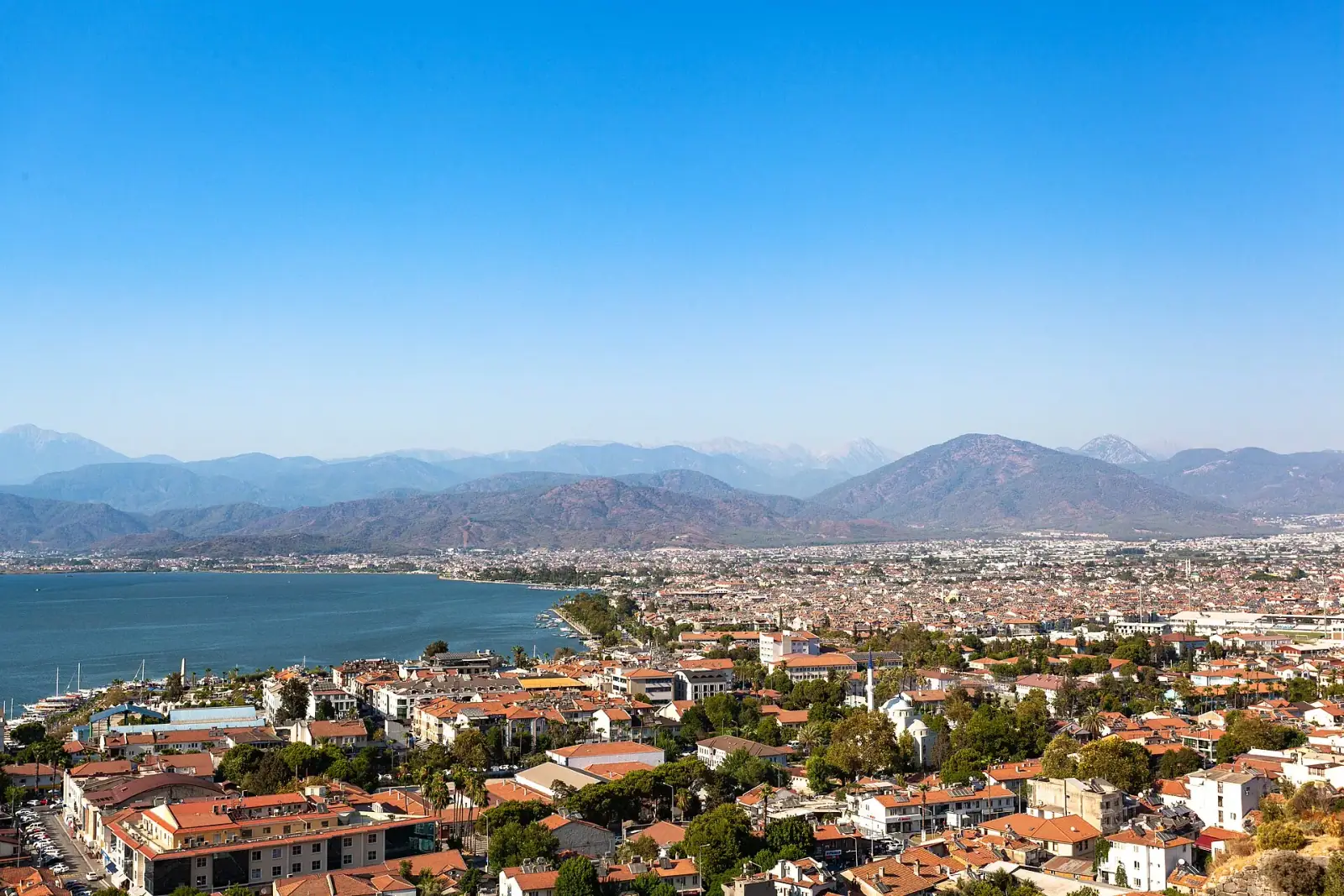

On the evening of 24 April 1957 an earthquake shook Fethiye, and before dawn a second, stronger one followed. By the time it was over, about nine in ten buildings in the town were damaged or destroyed, and a few metres of the harbour quay had broken away into the sea. The houses that fell were mostly rubble stone laid with little mortar. On the flat ground by the bay almost nothing was left standing; only on the slopes toward the mountain did some buildings hold.
Above them, the Lycian rock tombs are still cut into the cliff, as they have been since the fourth century BC. The best known, the Tomb of Amyntas, looks down on the town with a temple front of two Ionic columns carved from the rock face. Almost everything below it, from the harbour promenade and the marina to the flats behind Çalış beach, belongs to the town rebuilt after that night, and to the rules that decided how high, where and how solidly it could be rebuilt.
Those rules are what a foreign buyer is really buying into. The paperwork is short and well marked: no law requires a lawyer, the title deed fee is 4 percent split between buyer and seller, and a home worth $200,000 can carry a residence permit. The risk sits in the building: whether it has its occupancy certificate, whether someone added a floor the plan never allowed, and which generation of inspection and earthquake rules it went up under.
So buy in Fethiye if you want to live in the home and will check its permit history before you fall for the view. Think twice if the plan is a holiday let that also pays for a residence permit, a plot in a protected valley, or a bargain flat with a roof terrace that appears on no approved drawing. The low skyline that makes the town pleasant is enforced, and the enforcement reaches your flat too.
| Title deed fee | 2% from the buyer, 2% from the seller |
|---|---|
| Residence permit through a home | Worth $200,000 or more when bought |
| Citizenship through property | $400,000 or more, no sale for 3 years |
| Property tax on a home | 0.2% of the municipal tax value a year |
| Height cap, town residential zones | 6.5 m (2 storeys) or 9.5 m (3 storeys) |
| Inspection firm's liability for the structure | 15 years from the occupancy certificate |
| Off-plan withdrawal right; latest delivery | 14 days; 48 months |
| Capital gains tax | None after 5 years; 2026 allowance about $3,070 |
| Foreign-owner caps | 30 ha per person; 10% of a district |
Prices are in US dollars at the Central Bank of Turkey exchange rate of 48.88 lira to the dollar (forex selling) on 25 September 2026.
A town rebuilt low, and kept low by its plan
The rebuilding was a state project. About two months after the earthquake, 470 temporary barracks went up for the homeless, and in 1958 the foundations were laid for 650 new houses, whose owners were chosen by lottery and paid in instalments over 20 years. The work coincided with the first years of tourism on this coast. Two broad boulevards now run north to south through the centre, and one carries the name of Adnan Menderes, the prime minister who came to see the ruins.
Today the town's zoning plan reads like a description of that low skyline. In the settled residential zones a plot is coded for two or three storeys, and the building is capped at 6.5 metres to the top slab for two storeys and 9.5 metres for three. Homes must have pitched roofs of clay tile, and at least 40 percent of a residential plot has to stay as open soil, with a tree for every 20 square metres.
The line that matters most to a buyer is the shortest: in homes, no terrace floor, setback floor or attic floor may be built. So when a listing shows a glassed-in penthouse or a third storey on a two-storey street, ask to see it on the approved project. If it is not there, it was built without permission, and it may be why the building never received its occupancy certificate.
Tourism zoning has its own trap. A licensed tourism facility counts as one independent unit that may not be split into condominium flats, construction shares or timeshares, and that status is written into the land register before a building permit is issued. An "apartment" sold inside a licensed hotel complex cannot become a titled flat of your own.
Read the building's age before its view
What matters about a Fethiye building is which rules it went up under, and two dates decide that. Turkey's licensed private building inspection firms started in 19 pilot provinces in 2001; Muğla was not among them, and the system reached every province on 1 January 2011. The current earthquake code has governed new designs since 1 January 2019.
Under that system, the inspection firm, the engineers and the contractor are liable for defects in the structural system for 15 years from the occupancy certificate. An older block had no such firm. That does not make it unsafe, but the paper trail is thinner, and an independent structural engineer's report is the sensible purchase before the flat itself.
The occupancy certificate, yapı kullanma izin belgesi, is known everywhere as iskan. A villa without it may have been extended beyond that permit, which matters twice: the state earthquake insurer, DASK, may refuse to cover a building whose structure was altered against its project. Some houses hold a Yapı Kayıt Belgesi from the 2018 zoning amnesty instead, which allows full title without iskan if every owner agrees. It regularises the paperwork, not the concrete.
Older blocks carry one more risk. Under the urban transformation law, a building near the end of its economic life or at risk of collapse can be declared risky; the finding goes onto the title register, and the owners get up to 90 days to demolish. Since November 2023 owners holding a simple majority of the shares decide how to rebuild, and the shares of those who refuse can be sold. In an older block, you sign up to your neighbours' decisions as well as your own.
Then read the title. The registry record for the exact unit shows the owner, any mortgage (ipotek), any creditor's attachment (haciz) and any annotation (şerh). Kat mülkiyeti is full ownership of a finished, certified flat; kat irtifakı is a share in the land with the right to a flat, which tells you the building has not been signed off. Get a current copy before any deposit changes hands.
Is your passport on the list?
Citizens of 185 countries may buy property in Turkey, but the list is not published: any land registry office will confirm your nationality on request. Dual nationals are judged on the more restricted passport.
The Land Registry Law caps one foreign individual at 30 hectares across Turkey, and all foreigners together at 10 percent of the private land in a district; for a flat in Çalış or a villa in Ovacık, neither binds. Military zones no longer need a clearance letter, because they are now entered in the land register in all 81 provinces.
The beach, the lagoon and the ghost village: land the plans hold back
The district sits inside the Fethiye-Göcek Specially Protected Area, declared in 1988. Its environmental plan sets the frame for every local zoning plan.
Start at the water. Turkish law keeps the shore under state control and open to everyone, so no deed includes the beach. Buildings in the coastal strip may come no closer than 50 metres to the shoreline boundary, and the land in between is kept for footpaths and recreation. A new flat sold as beachfront stands behind a public strip, not on the sand.
Çalış, the long shingle beach where the summer water taxi from the harbour lands after a half-hour crossing, is also a loggerhead turtle nesting beach. Within 100 metres of the shoreline boundary there, the protected area's plan allows building work from May to September only in daylight, keeps outdoor lights below 1.5 metres, and requires light from rooms visible from the sand to be screened. A sunset flat on the Çalış front comes with curtains.
Inland, village houses may show no more than two storeys from any side, at most 6.5 metres, with no extra floor gained from the slope, until detailed plans are approved. Olive groves are protected harder: on a grove plot under 5,000 square metres the town plan allows 75 square metres of building in all, so a field of olives is not the cheap villa plot it looks.
History holds land back too. Kayaköy, eight kilometres south, is a hillside of about 500 ruined stone houses and two Greek Orthodox churches, emptied in 1923 when its people were sent to Greece and damaged again in 1957; the ruins are a protected monument. Most of ancient Telmessos lies under modern Fethiye, and its theatre was uncovered inside the town only in 1993. A plot in a protected site is referred to the culture or environment ministry before a foreigner can buy it.
Ölüdeniz, the lagoon where paragliders drift down from the mountain, is protected as well. Bare land carries its own clock: a foreigner who buys an unbuilt plot must submit a development project to the ministry within two years, or the land is sold off. If the dream is a plot in the hills above Üzümlü, budget for an architect from the first day.
Paying for it: dollars in, lira out, one price on the deed
A foreign buyer cannot simply transfer lira. The Central Bank's capital movements rules require anyone without Turkish citizenship to pay in foreign currency, sold to a Turkish bank before the deed is signed. The bank issues a foreign currency purchase certificate, the DAB, and sends it to the registry by registered e-mail. There are no exemptions, not even for long-term residents or spouses of Turks.
The DAB also fixes the price: its lira amount is what you declare, and the fee is charged on that figure but never on less than the municipal tax value, with a penalty for under-declaring. A low price on the deed is simply not open to a foreign buyer.
Many guides still insist on a licensed appraiser's report. For an ordinary purchase, the valuation report requirement for foreign individuals has been lifted; it survives only for citizenship. An independent valuation is still the one neutral number you can get before your money changes currency.
The signing at the land registry
You need a Turkish tax number, the DAB and a DASK earthquake policy, without which the registry will not register the transfer. You apply through WebTapu or at any land registry office in Turkey, not only Fethiye's; the office texts you the fees, and after payment a signing time.
The title deed fee is 2 percent from each side: on a $200,000 home, $4,000 from you and the same from the seller, plus a fixed registry service fee. The two sides can agree that one pays both halves, but the registry still treats each as liable for its own share.
Bring your passport, a recent photo and the identity declaration form. If you do not speak Turkish, a sworn translator authorised by a regional judicial commission must attend; our Fethiye services directory lists 62 translators in the town from the Ministry of Justice register. Buying from abroad needs a power of attorney from a foreign notary, with your photograph sealed by the notary: one without it is rejected.
Buying a flat that is not built yet
New projects around Fethiye are often sold unbuilt, and consumer protection law covers a foreign buyer too. Test the first rule: no pre-paid sale may be made before the building permit is issued. Confirm the permit number at the municipality before paying anything. The contract must be registered at the land registry or made before a notary.
After signing you can withdraw within 14 days without a reason. Delivery must come by the contract date and never later than 48 months, and you may cancel within 24 months for compensation of 2 to 8 percent of the price, depending on timing. A deposit asked for by ordinary transfer before the notary falls outside all of this.
Need a lawyer or a sworn translator in Fethiye?
We list the English-speaking lawyers and the court-register translators in Fethiye, each with the official source it came from, so you can check them before you call.
See Fethiye providers →Where a lawyer earns the fee
Nothing in the registry process makes a lawyer compulsory, but the law reserves legal advice for lawyers. In Fethiye a lawyer can check the registry record, iskan and zoning, sign for you under a power of attorney and assemble a citizenship file. On an off-plan purchase, the contract check is where the fee pays for itself.
A lawyer in Fethiye belongs to the Muğla Bar Association, which also covers Bodrum and Marmaris. Ask for the bar registration number and a written fee agreement. Our page of English-speaking lawyers in Fethiye lists seven from the UK Foreign Office's list, and lawyers across Turkey covers 191 in eight cities, including 38 in Antalya.
Living in it: the $200,000 residence permit
Owning a home is a listed ground for a short-term residence permit, with one national figure. The migration authority's document checklist requires a home worth at least $200,000 on the date you acquired it, so a later fall in the lira does not push you under.
The catch is in the same checklist: the home must be residential, lived in by you, and not rented out for income. That rules out the villa let to holidaymakers every summer; short lets of up to 100 days now also need a tourism ministry permit and, in a shared building, every owner's consent. Permits run up to two years and renew while you own the home.
To stay without buying, Turkey's digital nomad visa asks for $3,000 a month from applicants aged 21 to 55; our nomad visa finder sets it beside the alternatives.
Citizenship at $400,000
The threshold rose from $250,000 to $400,000 for purchases from 13 June 2022. The deed carries an annotation that the property will not be sold for three years, the full price goes through a bank with a DAB, and an official valuation confirms the value. Shares bought since 1 February 2023 no longer count, nor since 12 December 2023 do agricultural land or unbuilt plots, so that olive field cannot carry an application either.
The yearly bills and the day you sell
Property tax goes to the municipality. The residential rate of 0.1 percent is doubled in metropolitan municipalities, and Muğla is one, so a Fethiye home pays 0.2 percent a year of its municipal tax value, in two halves in spring and November. The DASK policy is renewed every year and pays after a 2 percent deductible. In a town where nine buildings in ten were damaged in one night, keep it current.
Hold the home five full years and the gain on sale is not taxed in Turkey. Sell sooner and the gain, indexed for inflation, is taxed at 15 to 40 percent above the 2026 allowance, worth about $3,070; a non-resident files a one-off return within 15 days. The net proceeds can be sent abroad through a bank. Bodrum shares the province, the tax rate and the bar, and our Bodrum digital nomad guide shows what living there is like.
Before you sign in Fethiye
Work in the order the risk runs. Check the registry record for owner, charges and title type. Get the permit file, approved project and iskan from the municipality, and compare them with what stands on the plot, floor by floor. Note the permit year. Only then convert the money, buy the DASK policy and book the registry.
From its cliff, the Tomb of Amyntas has looked down on every version of this town, including the stone one that fell in 1957 and the one that replaced it under new rules. The home worth buying below it is the one whose papers show it was built to those rules, not merely near them.
Thinking of living in Fethiye before you buy there?
Our Fethiye city guide covers the neighbourhoods, costs, internet and seasons that decide whether a home here works for remote work all year.
Read the Fethiye city guide →Frequently Asked Questions
Do I need a lawyer to buy property in Fethiye?
No. The land registry draws up the deed and no law requires a lawyer, though you need a sworn translator if you do not speak Turkish. A lawyer helps with title and iskan checks, off-plan contracts and citizenship files.
Can foreigners buy property in Fethiye?
Yes, if your country is among the 185 whose citizens may buy in Turkey. Limits are 30 hectares per person and 10 percent of a district for all foreigners, and unbuilt land needs a development project within two years.
How much are title deed fees in Fethiye?
4 percent of the declared price, 2 percent from each side, though the contract can put both on one side. On a $200,000 home, each share is $4,000.
Why are most Fethiye buildings only two or three storeys?
The town was rebuilt after the 1957 earthquakes, and its zoning plan caps homes in the settled residential zones at 6.5 metres for two storeys or 9.5 metres for three, with tiled pitched roofs and no terrace or attic floors.
What is the minimum property value for a Turkish residence permit in Fethiye?
$200,000, measured on the date you acquired the home, the same in every Turkish city. The home must be residential, lived in by you, and not rented out.
Can I get Turkish citizenship by buying a home in Fethiye?
Yes, with property worth at least $400,000, a three-year no-sale annotation and the price converted through a bank. Shares bought after 1 February 2023, and farmland or unbuilt plots bought after 12 December 2023, do not qualify.
Do I pay capital gains tax when selling property in Fethiye?
Only within five years of buying. The gain above the 2026 allowance of about $3,070 is taxed at 15 to 40 percent after inflation indexing, and non-residents file a one-off return within 15 days.


