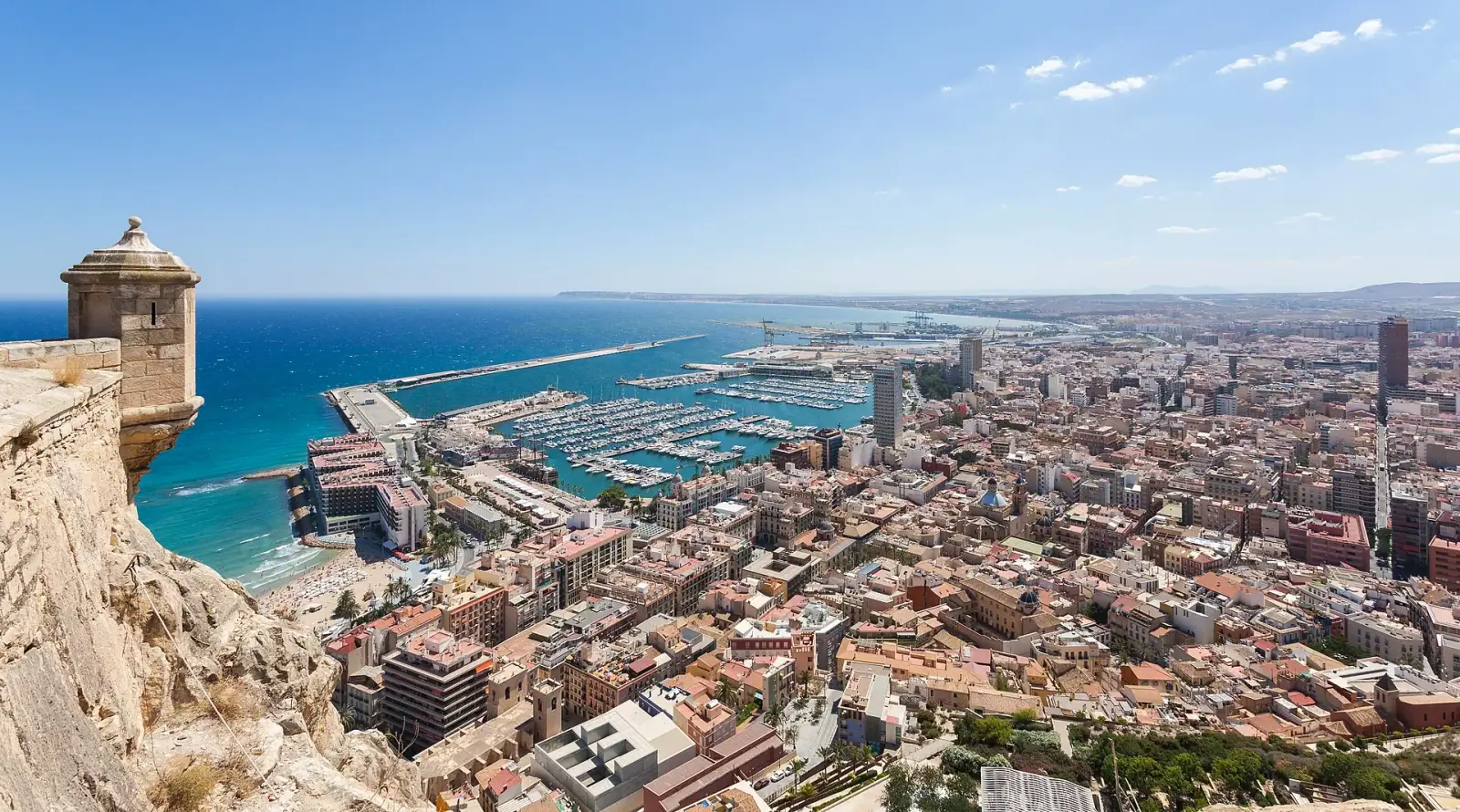

A flat in Spain changes hands at a notary's table, and in Alicante on a weekday morning five or six people sit down at one: the seller, you with your passport and NIE, and, if you are borrowing, someone from the bank to sign the mortgage in the same sitting. A few streets away, down on the Explanada de España, 6.6 million marble tiles ripple in red, cream and black between rows of palms and the port, and Santa Bárbara castle watches from the top of Mount Benacantil.
At the head of the table sits the notario, a public official who works for neither of you. The notary reads the deed aloud or lets you read it yourself, records the tax numbers of everyone buying and selling and how the price was paid, and gives the document the force that lets the Land Registry put your name on the flat. If your Spanish cannot carry a legal text, there is one more chair: an interpreter you chose.
That table is the best map of Spain's legal professions. The notary authorises. The gestor administrativo, who may have filed your residence papers months earlier, files forms. The abogado, if you hired one, is the only person in the room paid to take your side, and the only one who can take a dispute to court. You will likely need a gestor, and a notary for any property or will. A lawyer you need less often than you fear, but earlier than you think: before the deposit.
Plenty of people reach that table. Alicante province has the highest share of foreign residents of any Spanish province, about one in four, from Colombia and Morocco as much as from Britain, the Netherlands and Italy. They come to a city with more than 3,000 hours of sun a year, and meet Spanish paperwork soon after.
| Notary's fee for the deed on a $288,000 home | about $420 plus 21% VAT |
|---|---|
| Land Registry entry, same home | about $220 |
| Transfer tax on a resale, Alicante (Valencian region) | 9%, 11% above $1.15 million |
| Transfer tax on a resale elsewhere | Málaga 7%, Tenerife 6.5%, Madrid 6%, Mallorca 8% to 13% |
| New build | 10% VAT plus stamp duty (1.4% in Alicante) |
| Withheld when a non-resident sells | 3% of the price |
| NIE number, police fee | $11.30 |
| EU registration certificate | $13.80 |
| Non-EU residence card (TIE), first / renewal | $18.50 / $22.20 |
| Digital nomad visa, income floor | $2,810 to $3,280 a month |
| Court claims you may file without a lawyer | up to $2,300 |
| Lawyer's or gestor's fee | freely agreed, plus 21% VAT |
Prices are in US dollars at the exchange rate of $1 = €0.8687 on 1 August 2026, the rate our city pages use; the thresholds themselves are fixed in euros in Spanish law.
Who sits at the signing, and whose side they are on
Start with the notary, because the misunderstanding starts there. A Spanish notary drafts the deed to fit what both parties want, explains what it means, and advises both sides impartially, with extra help for whoever needs it. That protects you from a clause you do not understand. It does not make the notary your adviser on whether the flat is worth the price.
The reading is a real step, not a ritual. The notarial regulations make the notary read the whole deed to you or let you read it, and record that you understood it and consented freely. You may also ask for the deed in two columns, Spanish beside your own language, even if your Spanish is perfect.
If the notary cannot explain the deed in a language you understand, the law adds a chair. The interpreter is a person you designate, named in the deed, who signs it with everyone else. Nothing requires a sworn translator, so a bilingual friend is legally enough. A professional is still worth considering: this is the moment the price, the charges and the payment terms are read out.
Two details at that table decide what you need beforehand. Every property deed must record the tax identification numbers of the parties, and the Land Registry will not record one that lacks them, so the NIE comes first. The deed also records how the price was paid, with any cheques handed over at the table copied into it. If you pay by banker's cheque, order it from your bank days ahead.
Anyone else can be there on paper. A buyer who cannot fly in can sign a power of attorney, and the person holding it signs in their place once the notary has checked that the powers are enough. That person can be the buyer's own lawyer, which is where the abogado finally takes a seat.
What has to happen before that morning
The real decisions are weeks old by then. A resale usually runs in two steps: a private deposit contract, the contrato de arras, then the public deed. Before the deposit, someone on your side should pull the nota simple from the Land Registry, the extract that shows the registered owner and any mortgage or charge on the flat. That check is the core of what a property lawyer does for a buyer.
The arras contract also decides who pays for the deed. The Civil Code puts granting it on the seller and the first copy on the buyer, unless the parties agree otherwise, and any change sits in the clause on gastos. Read it before you pay the deposit, not at the notary's table.
A mortgage brings its own protection. The bank must hand you the loan documents at least ten calendar days before signing, and you are entitled to free, personalised advice on them from the notary you choose. Take it: that session is the one moment a notary sits down with you alone.
The notary's own fee is small and predictable. The royal decree on notarial fees charges a falling rate on successive slices of the price, less a compulsory 5% reduction, so on a $288,000 flat the deed costs about $420 before VAT. The Land Registry's own scale adds about $220. Both follow from the price alone, so you can work them out before you make an offer.
The big number is regional tax. In the Valencian region, transfer tax on a resale fell from 10% to 9% on 1 June 2026, so guides written before this summer overstate the cost in Alicante: on that flat it comes to about $25,900. The finance ministry's survey of 2026 regional taxes gives the other regions in the table above. A new build pays VAT and stamp duty instead.
The abogado: the only chair on your side
An abogado must belong to a Colegio de la Abogacía, a local bar, to act before the courts. Bars are local rather than regional: Alicante province alone has four, in Alicante, Elche, Alcoy and Orihuela, and the provincial one regulates about 4,500 lawyers.
Court is where the law makes a lawyer compulsory. A civil claim must carry a lawyer's signature, except small claims heard orally and the opening petition of a debt claim, and most cases also need a procurador, who files papers with the court on an official tariff and is normally brought in by your lawyer.
Outside court nothing forces you to hire one. You can buy a flat, apply for a visa or file a tax return alone. The catch is the table you just sat at: the notary works for both sides, the registry records title, and the estate agent is paid when the sale completes. Nobody else in the chain is paid to find the problem.
EU lawyers can practise here too. A German Rechtsanwalt or an Italian avvocato may work in Spain permanently under their home title after registering with the Spanish bar where they keep their office, so they appear on a Spanish bar's register either way.
The gestor: the professional of forms
The gestor is the profession foreigners meet first and understand least. A gestor administrativo files paperwork with public offices for you: vehicle transfers at Tráfico, tax forms, company registrations and residence applications. Gestores have their own colegios, Alicante's separate from Valencia's, under a national council that publishes a public register of members.
The state fees behind that paperwork are small: the Policía Nacional charges $11.30 to assign an NIE, and the residence documents in the table cost little more. Anything above them on an invoice is the professional's own charge, and none of it needs a lawyer.
A gestor is not a lawyer, though. When an application is refused, the appeal is legal work, and so is any dispute. For a routine filing, a gestor is built for the job. For anything contested, or a case with a history such as an earlier refusal or an overstay, hire an abogado from the start, and in either case ask which colegio the person signing belongs to.
Sworn translators and tax advisers
The interpreter at the notary's table can be anyone you trust. A translation you file with an authority is different: it needs a traductor-intérprete jurado, who holds a title from the Ministry of Foreign Affairs and whose translations are official before courts and public offices. The ministry keeps a searchable list of them but publishes no fees, so you agree the price directly. Our Alicante profile counts 120 translators and interpreters in the city; check a name against the ministry's list.
Tax advice comes from an asesor fiscal, a tax lawyer or a gestor, and no law requires any of them. Two questions are worth paying for: whether you are resident in your first year, and the six-month window of the regime for new arrivals, both below.
The digital nomad visa: forms, or a case?
Spain's international telework permit sits in the law on entrepreneurs and their internationalisation. You must work remotely for companies based outside Spain; if you are self-employed, Spanish clients may make up no more than 20% of your work. You need a degree or three years' experience, and the company must have been operating for at least a year.
The income floor is twice the minimum wage, read two ways. The consulate in Washington asks for $2,810 a month, doubling the monthly wage; spread the annual wage over twelve months and it is $3,280, the figure in our digital nomad visa comparison. Income above the higher number clears both. A consulate issues a visa for up to a year; from inside Spain you apply online for up to three years, and if nobody decides within 20 days, the permit counts as granted.
Filing online needs a Spanish digital certificate or a representative who holds one, which is where most people hire help. A gestor or lawyer can file a clean case. An abogado earns the fee when it is not clean: a freelancer near the 20% line, dependants, or a refusal that needs an appeal. The Canary Islands differ on tax, which our Las Palmas digital nomad guide explains.
Thinking of settling in Alicante?
Our Alicante profile puts rent, purchase prices per square metre and a monthly budget in dollars next to the lawyers, doctors and translators we list there by language.
Open the Alicante profile →When you are the one selling
Years later the table can be reversed. If you sell while non-resident, the buyer must withhold 3% of the price for the tax agency, about $8,630 on a $288,000 flat, credited against your capital gains tax when you file. The buyer also becomes liable for the municipal plusvalía, a tax on the rise in land value, so expect an estimate of it to be held back too. Since 2021 none is due where there was no gain, and the return is due within 30 working days of the sale.
Inheritance: the table, one generation on
Sooner or later the Costa Blanca's homes pass to the next generation, and the heirs sit down at a notary's table of their own. Under the EU Succession Regulation, the estate follows the law of the country where you were habitually resident when you died. A Briton or an American living in Alicante therefore gets Spanish law, which reserves a share for children, unless a will expressly chooses the law of their nationality. That alone is a reason to sign a Spanish will at a notary.
After a death, the heirs request a certificate from the national register of wills, then accept the estate in a notarial deed, which the Land Registry needs before it records the property in their names. Inheritance tax is due within six months, extendable by six more if requested within the first five.
The tax itself is often small for close family. Non-resident heirs may apply the rules of the region where the deceased lived or where most of the Spanish estate lies, and for children and spouses those cut the bill by 99% in Valencia, Andalucía and Madrid, 100% in the Balearic Islands and 99.9% in the Canaries.
Tax residency: 183 days and the Beckham regime
You become tax resident if you spend more than 183 days of the calendar year in Spain, or if your main base of economic interests is here, and sporadic absences still count as days here unless you prove residence elsewhere. A remote worker who spends the year in a flat above Postiguet beach is resident, and taxed on worldwide income.
The regime for new arrivals, known as the Beckham law, taxes qualifying work income at 24% up to about $690,000 for the year of the move and the five after. Since the 2022 reform it covers remote workers, but the text names employees holding the telework visa, so a self-employed nomad does not qualify through that clause. The option must be taken within six months of your Social Security registration, and that deadline is where an asesor fiscal earns the fee.
Hiring a lawyer: price, licence and language
Spain has no official fee scale for lawyers. Fees are freely agreed, and the law forbids bars from publishing even guidance on them, so no bar in Alicante can quote you a going rate. What you get instead is a right to a quote: since December 2024 any client may ask for the engagement in writing, in a hoja de encargo with a budget of fees and costs. Get it before you pay an advance, and compare two on the same scope.
Then check the licence. Every lawyer must give you their name, bar and membership number (número de colegiado), and someone who cannot is not practising as an abogado in Spain. The national council of Spanish bars publishes a census of practising lawyers, the Censo de Letrados, and each bar runs its own search: in Alicante, the provincial bar, ICALI.
Language is the last filter. We list a lawyer only where a published source, mostly an embassy's or consulate's list, states the language they work in. That gives 27 lawyers in Alicante who work in English, French or German, 19 on Málaga's list of English, Italian and French-speaking lawyers and 9 on Tenerife's list of lawyers, six of whom work in English. For German, there are 66 German-speaking lawyers in Spain, most of them in Madrid.
Before you sit down at the table
Order matters. Get the NIE first, through a gestor if Spanish or time is the obstacle. If you are buying, hire the lawyer before the arras, not after: the nota simple and the gastos clause are cheap to check and expensive to discover. Choose the notary yourself, and take the free mortgage advice in the ten days before signing.
On the morning, bring the cheques and an interpreter if the Spanish is beyond you. When the notary has read the last page, everyone signs, and the flat is yours. Afterwards you could walk down to the Explanada and take the lift from Postiguet beach up to Santa Bárbara, for the view over the bay you just bought into.
Find a lawyer who works in your language
We list 420 lawyers across 18 Spanish cities, each with the published source that names the languages they work in.
Browse lawyers in Spain →Frequently Asked Questions
Do I need a lawyer to buy property in Spain?
No law requires one. The law requires a notary, because the Land Registry only records a purchase made in a public deed. The notary advises both sides impartially, so only a lawyer of your own checks the registry extract and the contract from your side.
How much does a notary cost in Spain for a property purchase?
The fee is fixed by royal decree and depends on the price. On a $288,000 home the deed costs about $420 plus 21% VAT, and the Land Registry entry adds about $220.
Can I sign a Spanish property deed if I do not speak Spanish?
Yes. If the notary cannot explain the deed in your language, you designate an interpreter, who is named in the deed and signs it too; they need not be a sworn translator. You may also ask for the deed in two columns, Spanish beside your own language.
What is the difference between a gestor and a lawyer in Spain?
A gestor administrativo files paperwork with public offices, such as NIE, residence and vehicle forms. An abogado gives legal advice, checks contracts, appeals refusals and represents you in court. A gestor is enough for a routine filing; a refusal or a dispute needs an abogado.
How do I check a lawyer is registered in Spain?
Ask for the bar (colegio) and membership number, which every lawyer must give you, and check it in the national Censo de Letrados or the local bar's own search, such as ICALI in Alicante.
How much does an NIE cost in Spain in 2026?
The Policía Nacional fee to assign an NIE is $11.30. EU citizens who settle pay $13.80 for the registration certificate, and non-EU residents $18.50 for a first residence card (TIE). Any higher total is a professional's fee.
How much income does the Spain digital nomad visa require in 2026?
Twice the minimum wage: the Spanish consulate in Washington asks for $2,810 a month for a single applicant. Computed on the annual minimum wage the floor is $3,280, so income above that satisfies either reading.


