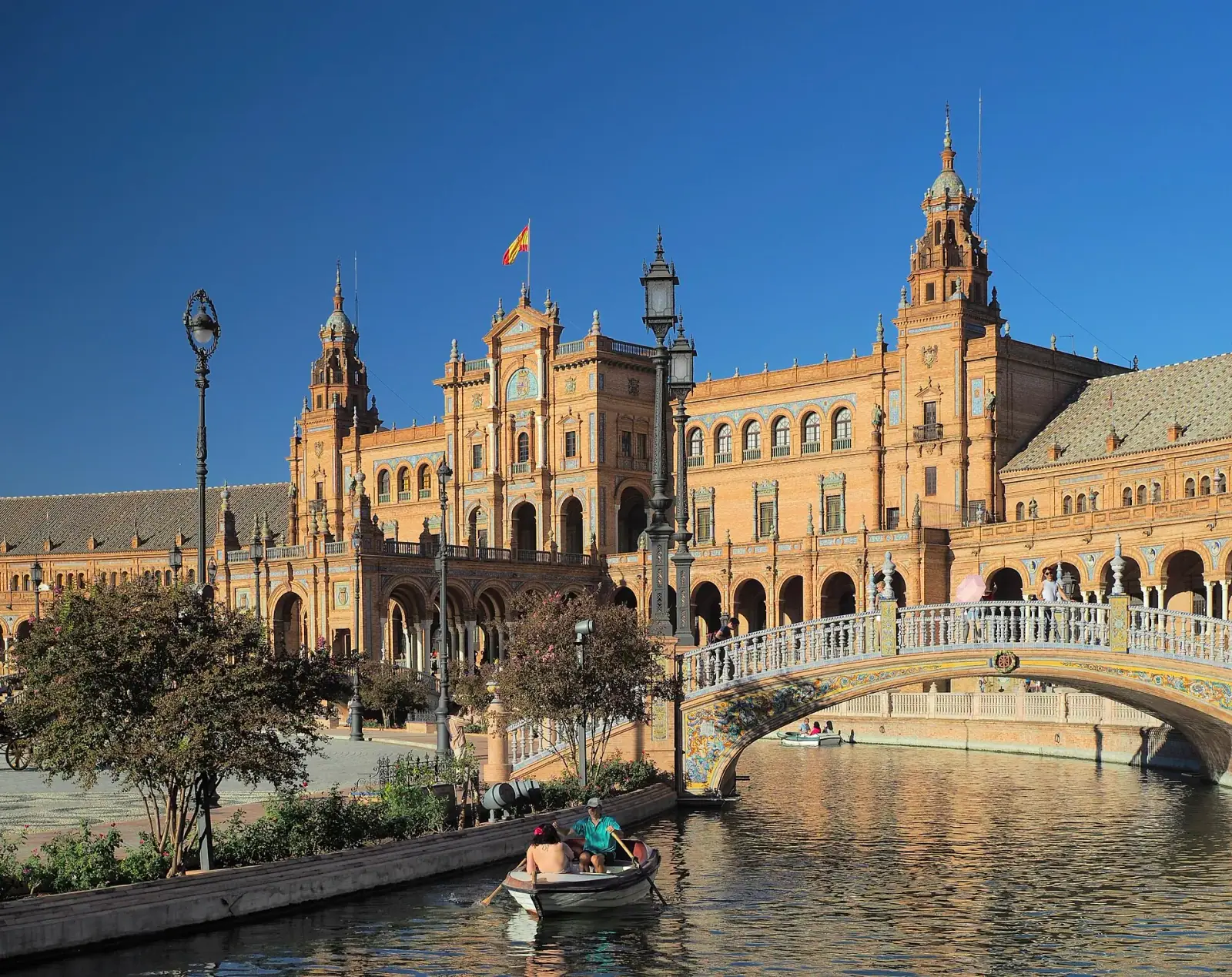

Seville Granada
Head to head
Seville vs Granada

Seville vs Granada: Which Is Better for Digital Nomads?

Overall: Granada edges ahead, 8 to 7.4

The standard way into either city used to be a fast train from Madrid. Since the collision at Urda on 28 October, which killed more than 60 people, high-speed services between Madrid and Andalusia have been suspended, with no reopening date and Renfe sales blocked until December. For the moment you will arrive some other way, and that turns out to be a good test, because how these two cities receive you is much like how they treat you after a year.

Coming in by air

Seville wins this outright. Its airport handled about nine million passengers in 2024, with Ryanair and Vueling based there and easyJet, Lufthansa, British Airways and Turkish flying in. Dublin, Manchester, Frankfurt, Istanbul, even Marrakesh are direct. You walk out to the Airport Express bus, which runs from about 04:30 until nearly 01:00, stops at Santa Justa station and ends 40 minutes later beside the river at Plaza de Armas, for about $4.50.

Granada's airport sees roughly a tenth of that traffic. The list is short enough to read aloud: Madrid, Barcelona, Paris Orly, Amsterdam, London Luton and some domestic hops. The Alsa bus runs about ten times a day, takes around 45 minutes and costs about $3.50. Miss the last one and it is a $35 taxi. Anyone flying out for work every month should stop here and take this seriously, since most trips from Granada will begin with a connection.

The first hour with a suitcase

Seville is flat. From Plaza de Armas you can roll your bag along the Guadalquivir, cross the Isabel II bridge into Triana, or head up to the Alameda, and the Giralda keeps you oriented. By the time you have dropped your things you will have noticed the orange trees along the streets, whose bitter fruit gets shipped to Britain for marmalade. Sevici docks and the short central tram mean you will rarely need a car. It is a city of nearly 700,000 that behaves like a much smaller one.

Granada starts easily and then tilts. Plaza Nueva is a fine place to begin, and the Carrera del Darro runs beside the little river with the Alhambra straight overhead. But if you booked the flat everyone wants, in a carmen in the Albaicín, your taxi will often stop short of the door, because many lanes are closed to cars, and you will finish the trip on foot and uphill. Do it anyway, then climb to the Mirador de San Nicolás at dusk. The Nasrid palaces and the Generalife stand across the valley with the Sierra Nevada behind them, and we know of no better first evening in Spain. Order a drink on the way down and a plate of food will come with it, free, as it usually does here.

The first hour in July and in January

Everyone warns you about Seville's heat, and rightly: some 60 days a year pass 35°C, and from about two until seven in summer the streets are empty. What fewer people mention is that Granada is only a degree cooler at its July peak. Its 738 metres help after dark, when the nights are more bearable. They do not help at four in the afternoon.

The altitude bites in the other direction. A Granada winter brings cold nights and the occasional frost, though you are also close to the ski slopes that hosted the 1996 world championships. Seville's January is the reason people forgive its August.

What the two would charge you

A month in Seville comes to about $2,400 by our estimate, and a month in Granada about $1,800. Local rents differ by much less, about $550 against $410 for a one-bedroom on a new lease, so much of the saving depends on not paying a foreigner's premium for a view. The rest comes from those free plates and from a city of 233,000 with some 47,000 university students, whose prices are set accordingly. The same Spanish rules apply to your stay in both.

So weigh your flights first. Monthly travel, or clients who expect you in person, means Seville. Without those, we would choose Granada for a year and pay for the odd connection with what it saves.

The cheapest way to find out is to use both doors. Fly into Seville, stay a week, take the three-hour bus across Andalusia, stay another week, and fly out of Granada. By the second airport you will know which suitcase walk you could face again.

Seville vs Granada: side by side

All 13 categories we rate, each out of 10. Green is strong, amber is middling, red is weak.

SevilleGranada
6 Climate 7
5 Cost of living 7
7 WiFi 6
8 Nightlife 8
5 Nature 8
7 Safety 7
8 Food 7
6 Community 5
5 English 5
7 Visa 7
9 Culture 9
7 Cleanliness 7
7 Air quality 7

Seville and Granada at a glance

212 kmapart in a straight line
Same timein January
$600a month less in Granada
Population, urban areaSeville1,212,000Granada388,000
ElevationSeville18 mGranada697 m
Time zoneUTC+1 in January, UTC+2 in Julyin both
Nearest airportSevilleSeville Airport (SVQ), 9 kmGranadaF.G.L. Airport Granada-Jaén Airport (GRX), 16 km
Main languageSpanishin both
CurrencyEuro (€, EUR)in both
PlugsType C/F, 230V / 50Hzin both
Tap waterSafe to drinkin both
Emergency number112in both
TippingRound up or 5-10%in both
Ride-hailingUber, Cabify, Boltin both
In the Schengen areaYesin both

Population is the Natural Earth figure for the urban area around each city, elevation from the Copernicus height model, airports from OurAirports.

Where they differ most

The three biggest gaps between the two, in the words of each city guide.

Nature

Seville

Seville is an urban city with limited wild nature nearby. The Guadalquivir River runs through it and has pleasant cycling and walking paths along its banks. Parque de Maria Luisa is the main large park, well suited for morning runs.

Granada

The Sierra Nevada is Granada's greatest natural asset: a ski resort operates in winter, and hiking trails are accessible year-round from about 30 minutes outside the city. The Alpujarras villages offer day-trip hiking through dramatic mountain scenery. The coast at Motril is roughly 70 km away.

Cost of living

Seville

Seville is one of Western Europe's most affordable major cities. A furnished one-bedroom apartment in the center runs $805-1,270/month, dropping to $575-865 in outer neighborhoods. Groceries cost around $230-345/month. A full tapas meal with a drink often costs under $12.

Granada

Granada is one of Spain's most affordable cities. A one-bedroom apartment in the centre runs $600-920 per month, dropping to $405-575 further out. The free tapa culture cuts food spending: most bars include a small plate with every drink.

Climate

Seville

Seville has a hot Mediterranean climate with scorching summers regularly exceeding 40 C (104 F) in July and August, making outdoor work or activity brutal. Spring (March to May) and autumn (October to November) are ideal with temperatures between 15-28 C.

Granada

Granada sits at around 700 metres above sea level, giving it a semi-continental Mediterranean climate with hot, dry summers regularly hitting 40C and cool winters with occasional frost. Spring and autumn are ideal: mild, sunny, and comfortable. Expect roughly 2,900 hours of sunshine per year.

From the score notes in the Seville and Granada guides, where each one is explained in full.

Month by month: the weather

Each bar runs from the average daily low to the average daily high. Rain is below.

SevilleGranadaScale runs from 1C to 36C, rain up to 78 mm
See the numbers
SevilleGranada
Jan16C / 6C, 56 mm13C / 1C, 39 mm
Feb18C / 7C, 46 mm15C / 2C, 32 mm
Mar22C / 10C, 47 mm18C / 4C, 41 mm
Apr24C / 12C, 51 mm21C / 7C, 37 mm
May28C / 15C, 33 mm25C / 10C, 31 mm
Jun33C / 19C, 6 mm31C / 14C, 8 mm
Jul36C / 21C, 1 mm35C / 17C, 1 mm
Aug36C / 21C, 3 mm35C / 17C, 3 mm
Sep32C / 18C, 32 mm29C / 14C, 27 mm
Oct26C / 15C, 74 mm24C / 10C, 42 mm
Nov20C / 10C, 72 mm17C / 5C, 49 mm
Dec17C / 8C, 78 mm14C / 2C, 44 mm

Seville: weather-station averages for 1991-2020. Granada: weather-station averages for 1991-2020.

What a month costs

Seville$2,400
Granada$1,800

What residents pay

SevilleGranada
$547 One-bedroom rent $408
$280 Groceries $280
$148 Eating out $148
$143 Utilities $143
$74 Local transport $74
$38 Home internet $38
$40 Phone $40

Our own estimate for a comfortable month for one remote worker, the same figure the city guides use. The lower lines are local prices: rent from the official statistics office named on each city guide, the rest from World Bank price levels.

Entry rules for common passports

Tourist entry on arrival. Every passport is in the visa finder, and remote-work visas are on the nomad visa page.

United States
Visa-free, 90 daysin both
United Kingdom
Visa-free, 90 daysin both
Germany
Visa-freein both
Canada
Visa-free, 90 daysin both
Australia
Visa-free, 90 daysin both
India
Visa requiredin both

Where you would live and work

The areas people choose in each city, and some of the places they work from.

Seville

Neighbourhoods

  • Santa CruzSeville's magical Jewish quarter maze
  • TrianaFlamenco soul across the river
  • Alameda de HérculesSeville's nightlife and alternative scene
  • El ArenalBullring quarter with tapas culture
  • NerviónModern Seville with shopping and stadium

Places to work

workINcompanyArcadia CoworkingSierpes 48Just Work Coworking SevillaLATE Specialty Coffee
More on the Seville guide →
Granada

Neighbourhoods

  • AlbaicínGranada's Moorish UNESCO labyrinth
  • SacromonteGranada's cave-dwelling flamenco soul
  • Centro/Cathedral AreaGranada's commercial and religious heart
  • RealejoGranada's former Jewish quarter
  • Alhambra AreaGranada's palace-garden crown

Places to work

Coworking CatedralGran Via Coworking SpaceWorkInn by ECO HostelTriskele Cafe CoworkingCoworking Street Art Cafe Granada
More on the Granada guide →

Services in a language you speak

Providers in our directory who work in a language other than the local one, from official registers, consular lists and the providers’ own websites.

Physiotherapists
2Seville
0Granada
Translators
1Seville
0Granada

Where each city wins

Seville is stronger on

WiFiFoodCommunity
Seville guide →

Granada is stronger on

NatureCost of LivingClimate
Granada guide →

Add a third city in the comparison tool →

Frequently asked questions

Is Seville or Granada cheaper for digital nomads?

Granada is the cheaper base, around $1,800 a month versus $2,400 in Seville, a difference of about $600.

Which has better WiFi, Seville or Granada?

Seville scores higher for WiFi (7/10 versus 6/10).

Which is safer, Seville or Granada?

Both rate 7/10 on safety.

Seville or Granada: which is better overall for remote work?

Granada takes the overall Nomad Score (8/10 versus 7.4/10), though the right pick depends on what you value most.