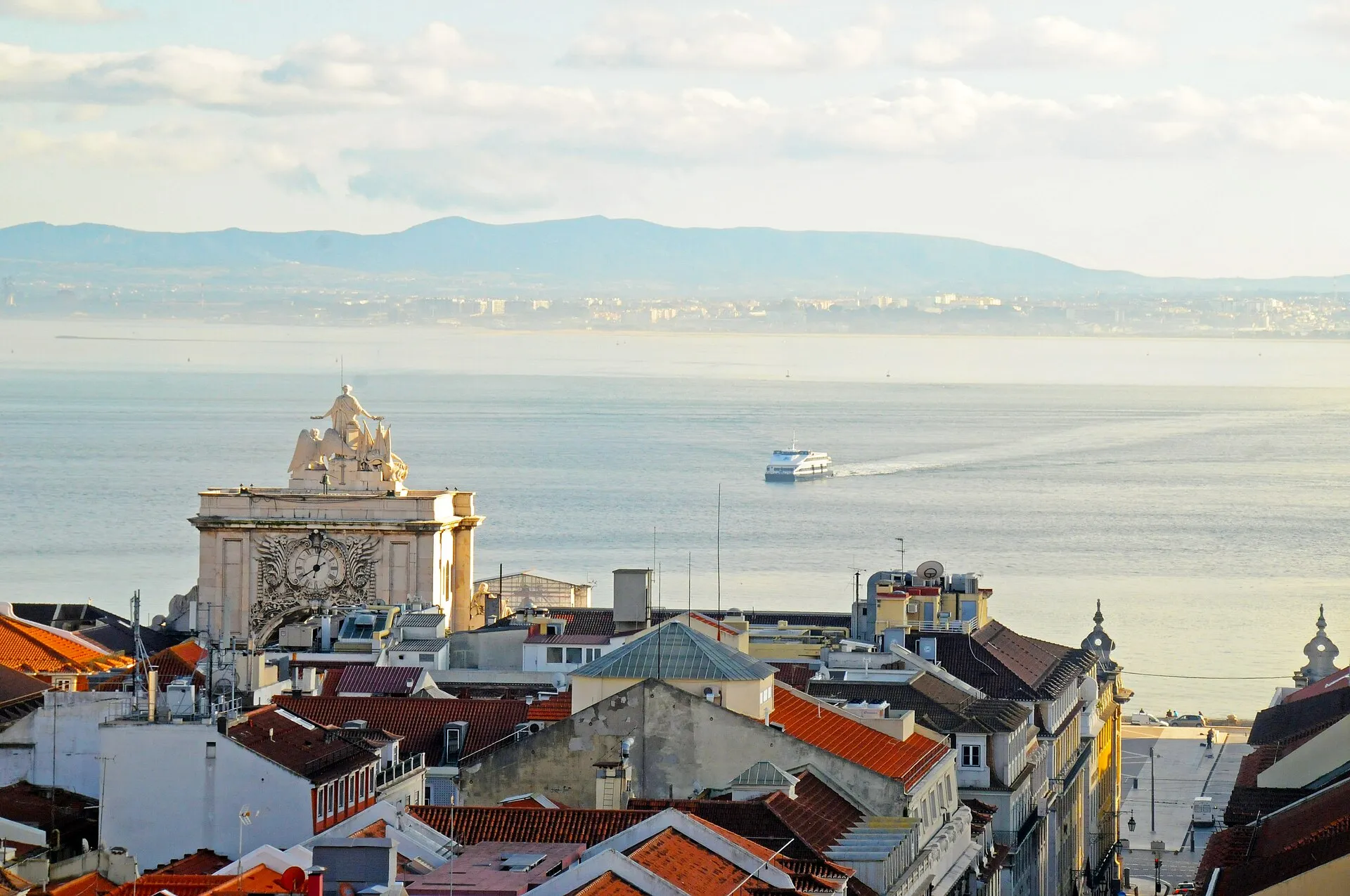

 Lisbon
 Valencia
Fly into each of these cities with two suitcases and no plans for the afternoon. The first hour will show you most of what the next year would be like.
Coming in to land
At Lisbon your window fills with the city. The airport sits inside the municipality, one of the few major airports whose approach runs directly over town, and you come in low enough to read the rooftops, with the Tagus spreading out behind them. It is one of the great arrivals in Europe. It is also a clue: more than 414,000 people live within five kilometres of that runway, and if your flat is under the flight path you will know it.
Your arrival at Valencia is plainer. The airport is out at Manises, in flat country eight kilometres west of the centre, and handled about 11.8 million passengers in 2025 against Lisbon's 36.1 million.
Passport control
If you hold a non-EU passport, this may be your longest wait of the day. Lisbon is among Europe's most congested airports, and it struggled badly with the EU's new biometric entry system: it was switched off there in late 2025 for that reason, then two-hour queues returned in spring 2026 as the system went fully live, until extra booths were added at the end of May. Queues may have eased since then, but give yourself a margin for any onward plans. Valencia's smaller airport has far fewer people to process.
The ride into town
This part is close to a draw. Lisbon's red metro line starts at the terminal and reaches Saldanha in about 16 minutes. In Valencia, metro lines 3 and 5 get you to the centre in about 15. Note that Lisbon's trains stop around one in the morning, which matters on late budget flights.
The walk to your door
Now the two cities part. Valencia stands 15 metres above the sea on the floodplain of the Turia, and after a flood killed 81 people in 1957, the river was moved out of town and its old bed turned into a long park that now runs through the city. Your suitcase wheels will roll easily. So will your bike, along that park to the City of Arts and Sciences or out towards the tram and the beach at Malvarrosa.
In Lisbon, your suitcase is about to become a problem. Alfama and Graça are lovely precisely because they are steep, and the old streets are not designed for wheels. Do not choose a flat counting on a funicular to carry you up: all were stopped after the Glória derailment killed 16 people in September 2025, and some were still under technical review in 2026.
That climb is also why you came. The view from the Senhora do Monte viewpoint, the light on the river, the sense of a small capital spilling down to its port: Valencia has nothing quite like it. Whether it charms you in month ten, carrying groceries uphill in November, Lisbon's wettest month, is a fair thing to ask.
What the first hour leaves out
The bill, first of all. We put a month at $3,500 in Lisbon and at $2,500 in Valencia, and the visa bar follows the same pattern: Portugal's nomad visa asks about $4,240 a month, Spain's about $3,280, as our visa page sets out. For most remote workers, that is the argument for Valencia right there.
The map is the second thing. Valencia is two hours by high-speed train from Madrid, so much of Spain feels close. Getting from Lisbon to Madrid by rail takes over ten hours with changes, so you will fly. In return, Lisbon has an Atlantic reach that Valencia lacks, while Valencia's transatlantic list amounts to a year-round Montreal flight, with Newark promised for summer 2027. If you cross that ocean often, it counts for a lot, and so do Lisbon's larger foreign community and its easy English.
The third is water. The October 2024 floods killed 234 people in Valencia province. The diverted Turia saved the city proper, while towns to its south such as Paiporta took the worst of it. So look at a map before you rent somewhere cheap on that side of the channel.
We lean towards Valencia, and we would pay Lisbon's premium only for the Atlantic or the company. When you visit either, skip the taxi and take the metro in with your bags: your arms will tell you more than any comparison can.
 United States
 United Kingdom
 Germany
 Canada
 Australia
 India