Say the email arrives on a Tuesday evening in Da Nang. Your brother has found a buyer for the family flat, the buyer's notary has set a date in three weeks, and every heir has to sign. You have a co-working desk with a sea view, a visa that runs until spring, and no plan to fly twelve hours to put your name on one page.
Most of that can now happen online. You book an appointment, verify your ID online beforehand, sign electronically on a short video call with a licensed notary, and the apostille that makes the document valid abroad follows minutes later. It does not suit every document or every office, and the question that decides it is not technical: will the person receiving your paper accept it?
Links to notarity in this article are affiliate links: we earn a commission if you book through them. notarity did not pay for the article.
How an online notary appointment works
notarity is a platform based in Vienna. It does not notarise anything itself: the notarisation is done by licensed partner notaries on the notarity platform, and which notary takes your appointment depends on the country where the document will be used, which you choose when you book.
- Book and upload. You book an appointment through the link, select the destination country (where the document will be used, not where you are) and upload the document. If you do not have one yet, a notary can draft it for you, which notarity prices at about $550.
- Prove who you are. Before the appointment you identify yourself online with photos of an original ID document and a selfie. A passport, national ID card, driving licence or residence permit all work, and so does an electronic ID such as ID Austria. The notary checks this identification beforehand, so there is nothing to show during the call.
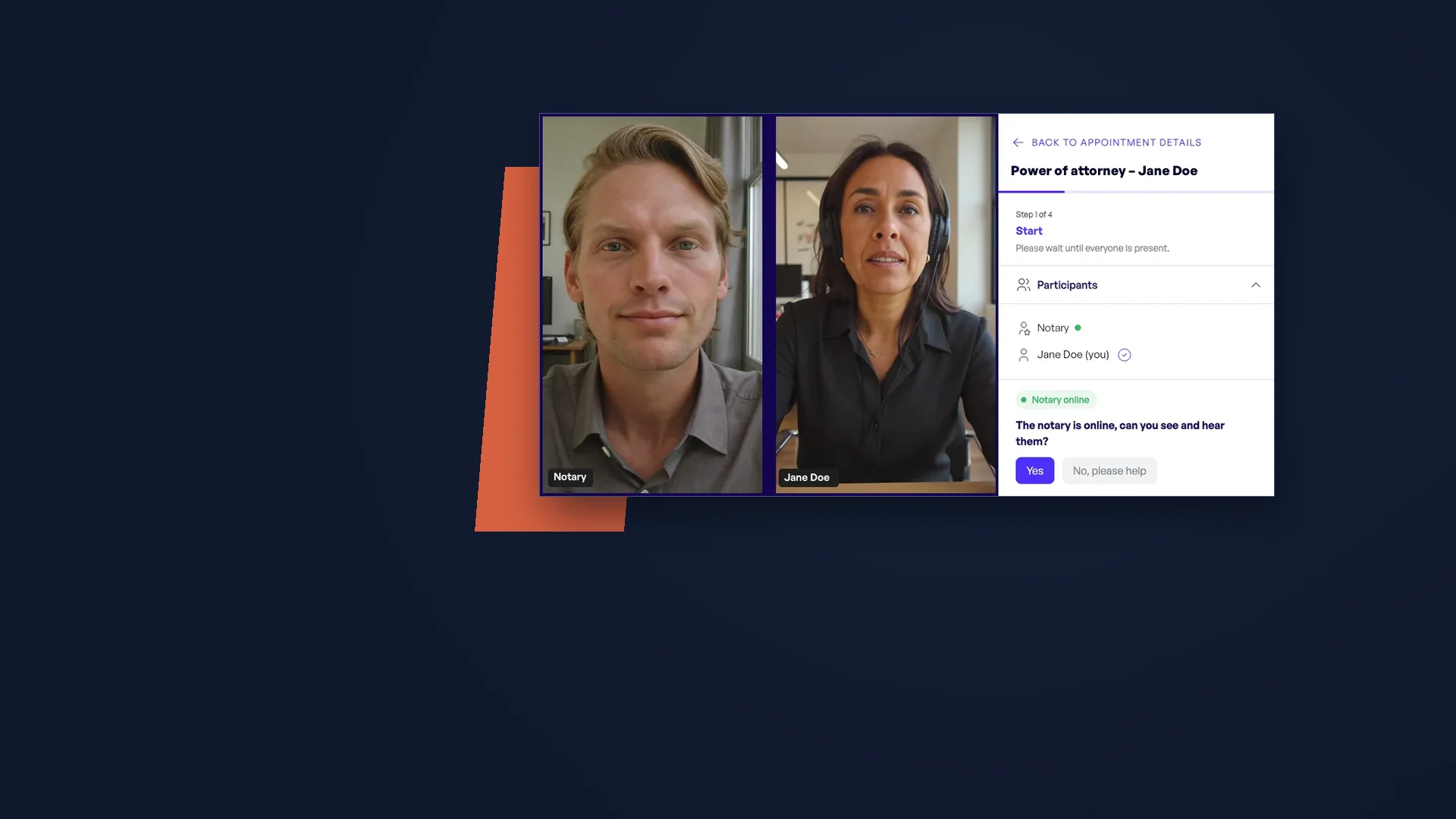
- Sign on the call. On a short video call with a partner notary you sign the document electronically and the notary notarises it. International appointments are held in English, and you can bring someone along to translate for you. If several people need to sign, each can join from a different country.
- Add the apostille. On request the document gets an apostille, so that it is recognised in the member states of the Hague Apostille Convention.
- Receive it. The notarised document is ready to download, digitally signed; it is not sent by email. If the recipient wants paper, an original with the notary's signature, stamp and seal can be posted to any address in the world.
| What you need | An original passport, national ID card, driving licence or residence permit, a device with a camera, a stable connection |
|---|---|
| Identification | Online before the appointment, with photos of your ID and a selfie |
| Where you can be | Anywhere: notarity sets no limit on where you join from |
| Booking | As little as one hour ahead |
| Video call with the notary | Usually under 10 minutes, in English; you can bring someone to translate |
| Notarisation | About $165 per document |
| Apostille | About $140 per document, usually issued minutes after the call |
| Paper original with the notary's signature, stamp and seal | About $70 per document, standard shipping to any address worldwide |
| Express shipping | About $70 more |
| Several signers in different countries | One document, charged once, not per signer |
| Language of the document | Any |
notarity's own prices including 20% VAT, converted at about $1.15 per euro (November 2026). They apply to every destination country except Austria and the UK, where the notary sets the price and sends a binding quote before the appointment.
Two choices matter more than the rest. The destination country is what routes you to a notary whose work that country will recognise: if the power of attorney is for a bank in Germany, you choose Germany, even if you are sitting in Medellín and hold a Dutch passport. And a digital document with a digital apostille is fastest, but some offices only accept paper. Ask before you book, and if the answer is paper, add the posted original in the same booking rather than ordering it later.
Book an online notary appointment
Upload your document, choose the country where it will be used and sign on a short video call with a partner notary on the notarity platform. Add an apostille and a posted original if you need them.
Book on notarity →What people living abroad use it for
Certified copies. A bank account abroad, a residence permit or a company registration often needs a certified copy of your passport or of a proof of address, sometimes with an apostille on top. A notary confirms that the copy matches the original you hold up to the camera. This is the most common request, and the one where a consulate is least likely to help.
Signatures on a power of attorney. The classic case for someone who has left: you authorise a relative, a lawyer or a property manager to act for you at home. Selling a flat, closing a bank account, dealing with an inheritance or signing for your company from the other side of the world all run on a power of attorney with a notarised signature.
Sworn statements. Affidavits and declarations under oath, for example confirming facts an authority asks you to confirm in writing, are notarial acts and can be done the same way.
Company documents. Shareholder resolutions, a change of managing director or a register filing often need a notarised signature. Founders whose co-founders live in other countries gain the most, because everyone signs the same document from wherever they are.
Certified translations. A foreign authority may want your document in its own language with a certified translation attached. Those are available through notarity's translation partner, Translayte.
Notarisation, apostille and legalisation
A notarisation is a notary confirming something: that you are who you say you are and signed, that a copy matches its original, or that you made a statement under oath. It turns your signature into a public document, which is what banks, land registries and courts want. On its own, though, it is only trusted at home: a Spanish land registry cannot tell whether a stamp from a notary in Vienna is real.
The apostille solves that. It is a standard certificate from an authority in the country where the document was made, confirming that the notary's signature and seal are genuine; it says nothing about the content. It comes from the Hague Apostille Convention, which 130 states have joined, recently China (November 2023), Canada (January 2024) and Vietnam (September 2026), with Thailand following on 28 February 2027. Existing members can object to a newcomer, and between those two the apostille does not apply, so check the status table when the country you deal with joined recently.
Outside the Convention you are back to legalisation, through the foreign ministry where the document was made and then the embassy of the country where it will be used. That applies to the United Arab Emirates, Malaysia, Taiwan, Cambodia, Sri Lanka, Egypt, Kenya, Nigeria and Qatar. It is slower, so if your document is headed to Dubai, plan for it from the start.
Check acceptance before you book
Whether a notarised document works is never up to the notary. It is up to whoever receives it: the bank, the registry, the foreign notary, the immigration office. notarity says the same about its own service. So send the receiving office three short questions before you spend money. Do you accept a document notarised by a notary in another country, signed by video? Do you need an apostille, or legalisation? Do you need the original on paper, or is a digitally signed document enough? Get the answer in writing.
Some acts cannot move online at all. A property purchase in Spain or Croatia is signed before a local notary, so buyers abroad sign a power of attorney and let someone else sit at the table; that power of attorney is the part an online appointment can cover, once the other side has agreed. Our guides to lawyers, gestores and notaries in Spain and to buying property in Split go through both.
Ask your bank at home the same questions, plus one more: whether it has its own power of attorney form. If it does, the notary has to certify your signature on that form, not on a document you wrote yourself.
A local notary or your consulate
If the paper is for use in the country where you live, a local notary there is the natural choice: they know what the local office expects, and a document that stays in the country needs no apostille. Our directory of notaries who work in English and other languages lists them city by city. For a document going elsewhere, the apostille has to come from that country's own authority, which can mean a separate trip and a wait.
Your consulate is narrower than most people expect. US embassies and consulates notarise in person by appointment for $50 per consular seal, which is often the cheapest route for a single signature if you live nearby. British missions offer very limited notarial services, send British nationals to local notaries for certified copies, and in Commonwealth countries cannot certify a copy at all.
What to do next
Start with the receiving office, not with the notary. Then pick the route: your consulate if it offers the service and you are nearby, a local notary if the document stays in your country of residence, and an online appointment for everything that has to travel, especially when you move every month or two or the signers are spread across countries. If you book online, order the apostille and any posted original in the same booking, and keep the digital copy: if the paper is lost in the post, you can show what was signed and when.
Need a notary in person?
Our directory lists notaries in cities around the world who work in English and other languages, each with the source behind the language claim.
Browse notaries by city →Frequently Asked Questions
Is an online notarisation legally valid?
Yes, in the jurisdiction where the notary is licensed, and with an apostille it is generally recognised in the member states of the Hague Apostille Convention. Whether a particular office accepts it is up to that office, so ask before you book.
Can I get a document notarised online while I live abroad?
Yes, from anywhere. You identify yourself online beforehand with photos of an original passport, national ID card, driving licence or residence permit and a selfie, then sign on a video call held in English. You can bring someone to translate.
How long does an online notary appointment take?
The call usually takes under 10 minutes and can be booked as little as one hour ahead. The apostille usually follows minutes later, so a document can be notarised and apostilled on the same evening.
How much does it cost to notarise and apostille a document online?
On notarity, about $165 per document for the notarisation and about $140 for the apostille, both including VAT, so about $305 for a digitally signed document with an apostille. A paper original posted anywhere in the world adds about $70, and express shipping about $70 more. For Austria and the UK the notary quotes the price before the appointment.
Which countries do not accept an apostille?
Countries outside the Hague Apostille Convention, including the United Arab Emirates, Malaysia, Taiwan, Cambodia, Sri Lanka, Egypt, Kenya, Nigeria and Qatar. Documents for them need embassy legalisation instead.
Can my embassy notarise documents for me?
US embassies and consulates do, in person by appointment, for $50 per seal. British missions offer very limited notarial services and refer British nationals to local notaries for certified copies.