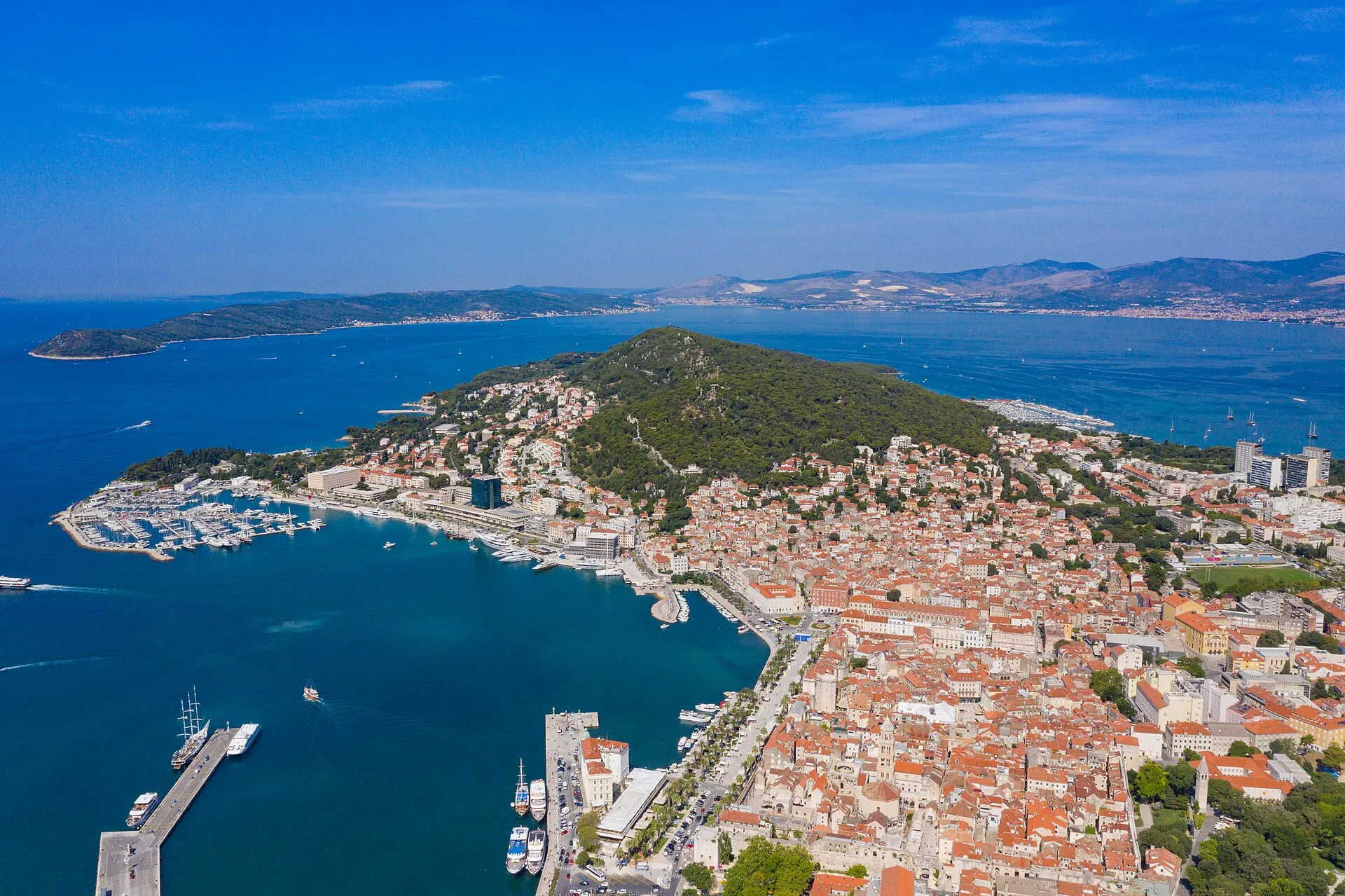

On the Peristyle in Split, people drink coffee on the steps between red granite columns that were raised so a Roman emperor could appear to his kneeling subjects. A 3,500-year-old Egyptian sphinx sits at the edge of the square, the cathedral behind it was Diocletian's mausoleum, and on the western side the Gothic and Renaissance houses of old Split families lean on the Roman columns and arches. This is not a ruin you visit. It is a neighbourhood you could buy into.
It became one by necessity. When the Avars and Slavs destroyed Salona in the 7th century, its people fled behind the walls of the emperor's retirement palace and built their homes inside it; the cellars under the imperial rooms became a rubbish pit for the households stacked above. The palace still forms about half of Split's old town, on UNESCO's World Heritage List since 1979.
A flat inside those walls holds the whole of Croatian property law in one building. The stone is older than any permit. Ownership is often divided floor by floor among families and heirs. The city has the first right to buy before you do. And before any of that, your passport decides whether you may buy at all.
The short answer: with an EU, Icelandic, Liechtenstein or Norwegian passport, you buy in Split as a Croatian would. From the US or the UK you can buy too, but only with the Ministry of Justice's consent, which takes months. Australians cannot get consent for an existing home until 31 March 2027, Canadians are waiting on the ministry, and nobody gets residence from owning a flat.
Dollar figures convert euro amounts at the exchange rate of 1 August 2026, $1.151 per euro. The example is a 55-square-metre central flat at the $7,270 per square metre our city page carries from Numbeo: about $400,000.
| Transfer tax, paid by the buyer | 3% of market value, $12,000 |
|---|---|
| Usual deposit (kapara) | about 10%, $40,000 |
| Agency commission | 2% to 3% plus VAT, $8,000 to $12,000 |
| Lawyer, bar tariff: contract / registration | about $7,500 plus VAT / $1,150 |
| Land registry court fees | about $38, half if filed electronically |
| Deadline to file for registration | 60 days, or a fivefold fee |
| Ministry consent, non-EU buyers, real wait | 2 to 6 months |
| City's time to answer a heritage-core offer | 60 days |
| Split property tax, second homes | $5.76 per m², about $317 a year |
| Tourist letting, per bed a year | $115 to $288 income tax, plus about $81 tourist tax |
Taxes and fees: Tax Administration, court fee tariff, Croatian Bar Association tariff, City of Split and county decisions. Deposit, commission and consent wait: independent buyers' guides in agreement. Example flat priced from Numbeo, August 2026.
Does your passport let you buy?
The line runs around the European Economic Area. Citizens and companies of the EU, Iceland, Liechtenstein and Norway buy property in Croatia exactly as Croatians do; the Swiss too, once they show a Croatian temporary residence certificate. For them, a flat near the Riva is bought like one at home: find it, check it, sign, register.
Everyone else needs the Minister of Justice's consent, which rests on reciprocity: Croatians must be able to buy in your country on similar terms. Trust the ministry's reciprocity list, country by country, over any buying guide. Britain passes. The United States passes, except that residents of Arkansas, Hawaii, Kentucky, Minnesota, Mississippi, New Hampshire, Oklahoma and Vermont must meet a permanent or long-term residence condition.
Australia is shut out for existing homes until 31 March 2027, mirroring its own two-year ban on foreigners buying established dwellings. Canada, Mexico and the UAE show "verification underway", which means no confirmed status, though commercial guides still tell Canadians and Australians they can buy. New Zealand passes with a cap on value and area; India and Taiwan do not.
Asking Zagreb for permission
Consent is decided in the capital. The file goes to the Ministry of Justice, Administration and Digital Transformation with the signed contract, a registry extract showing the seller owns the flat, an urban planning certificate, a certified passport copy, and a representative in Croatia if you live abroad.
Note the order: you sign the purchase, then ask whether you may complete it. So a contract for a non-EU buyer should make consent a condition, with the deposit returned in full if the ministry refuses. On paper the ministry has 60 days and you can appeal if it runs over; independent buyers' guides agree the real wait is two to six months. Plan around the long end.
One change is already law and not yet in force. In March 2025 Parliament exempted citizens of every OECD member state from consent, from the day Croatia joins the OECD. When OECD ministers met in June 2026 Croatia was still a candidate, and we found no record of accession since. Applications filed before that day will still be decided under the old rules.
Inside the walls, the city buys first
Back to the palace. The law on cultural goods gives the public a right of first refusal over property inside a World Heritage ensemble, and Split's historic core is one. Before selling, the owner must offer the property to the state, the county and the city at once, with the price and terms. The city comes first in line.
They have 60 days to answer. After that the owner may sell to you, but not for less than the offer price and not on better terms. Skip the step and the city can sue to annul your purchase, within 90 days of learning of it and up to five years after the contract. The seller must show you the waiver documents, so ask for them before the deposit.
The council decides these offers one by one and publishes each waiver with its price. At one session in February 2025 it waived four, among them a 40-square-metre second floor on Dominisova, a lane inside the palace a few steps north of the Peristyle, offered at about $299,000. That is close to what our central price per square metre predicts, and a useful check on any asking price in the old town.
Owning inside the walls also limits what you may change. Works on a cultural good need the Ministry of Culture and Media's approval or a permit issued under the heritage rules, so a new bathroom or a window in Roman masonry starts with the conservators. Price that approval in time as well as money.
Reading the folio, line by line
First, an OIB, the eleven-digit number the notary, the court, the bank and the tax office all key your file to. Email a request form and a passport scan to the Tax Administration and collect the certificate in person; it promises priority handling within eight days, and the registry filing must carry both parties' OIB.
Croatia keeps two records of every plot. The cadastre holds the technical facts: parcel, area, use, buildings. The land registry adds the rights: who owns it and what burdens it. The two long lived in separate databases that did not match, and you can now read both on the public Uređena zemlja portal with a parcel or folio number.
The extract has three sheets: A describes the property, B names the owners and any limits on selling, C lists mortgages, pre-emption rights, leases, easements and enforcement. You want the seller on sheet B to be the person signing, every co-owner and heir accounted for, and sheet C empty or cleared from your money at completion. Check too for a plomba, the seal marking a pending application.
Then ask whether the flat is registered as a separate unit or only as a share of the building. Picture Varoš, the old quarter of farmers and fishermen on Marjan's eastern slope: narrow stone lanes and small houses, many now converted into apartments and hostels. A house divided into flats over generations is exactly where registry and building drift apart.
Old stone, missing permits
A building may be used only once it has a usage permit, with an exception that suits Split: anything completed before 15 February 1968 counts as having a final building permit. Much of the centre, from the palace to Varoš, predates that line comfortably.
The trouble is what came later: an extra floor, an attic, a closed-in terrace. Legalisation closed in 2018 and reopened when an amendment abolished the deadline in May 2026, for structures standing by 21 June 2011 and visible on the state's aerial photograph of that date, with a fee for the illegal construction. Anything newer can never be legalised. Ask the seller in writing which permit covers each part, and make the answer a condition of the preliminary contract.
When the house comes with olive trees
Take a ferry from Split's harbour to Brač or Šolta and the listings change: a stone house with a garden, olive trees, a terrace of vines. Here a second law applies. Foreigners cannot own agricultural land except by treaty, special law or inheritance with reciprocity; EU, EEA and Swiss citizens have bought it on Croatian terms since 1 July 2023.
The cadastre decides what counts, and gardens, orchards, meadows, olive groves and vineyards all do. A cottage whose garden is recorded as an olive grove sits under two regimes, and a non-EU buyer can take the house and still be barred from the grove. Even in town, record and reality drift: Bačvice was vineyards, orchards and gardens until the end of the 19th century. Check every parcel number.
From the deposit to your name on sheet B
Sales usually begin with a preliminary contract and a deposit, the kapara, about 10% of the price. Once paid, the contract is concluded, and unless it says otherwise neither side can simply walk away. If the seller causes the sale to fail, you can demand completion, or damages with your deposit back, or double the deposit; if you cause it, the seller keeps it. So tie the money to conditions: consent, a clean sheet C, the permits, the heritage waiver.
The main contract need not be a notarial deed. The registry accepts a private contract if a notary certifies the seller's signature and the text consents to your registration as owner. If you do not read Croatian, have it drawn up in both languages and bring an interpreter; we list the 135 court interpreters and translators in Split by language.
A notary or lawyer files electronically with the land registry of the Split Municipal Court; paper is rejected. File within 60 days or the fee is charged five times over. The court seals the folio the moment the application arrives, which protects you against a second sale, and decides within 15 working days. Once you are on sheet B, the law protects you as a buyer who relied on the registry in good faith.
Need someone to read the folio for you?
Our Split directory lists eight lawyers who work in English or Italian, each traced to the official list that names them.
See lawyers in Split →What the flat costs on top of the price
The largest extra is the transfer tax: 3% of market value, paid by the buyer within 15 days of the assessment. It is levied on market value, so an understated price can be reassessed. A new flat bought from a developer with VAT is outside the transfer tax. On the example flat that is $12,000, and an agent adds $8,000 to $12,000 before VAT, often negotiable.
The lawyer is the figure people misjudge. The Croatian Bar Association's tariff prices a contract by its value, about $7,500 plus VAT here, but it lets the fee rise or fall with the work and lets you agree any fee in writing. Treat it as a reference and get a written quote.
Then the yearly bill. Unless the flat is your permanent home or let long-term for ten months a year, it pays property tax. Split charged $2.29 per square metre for 2025, and the council has voted, as the local press reported, to raise it to $5.76 from 2026: about $317 a year on the example.
Who handles the file
No law makes you hire a lawyer to draft the contract, but only a notary or a lawyer can file the registration, and a non-EU buyer needs a consent file. With your power of attorney a lawyer can read sheets B and C, chase the permits and the heritage waiver, draft the conditions and file inside 60 days while you are abroad. Check any name with the Croatian Bar Association, where every practising lawyer is entered.
Our directory of real estate lawyers in Split who work in English or Italian lists eight, five from the UK Foreign Office's list and three from the Italian embassy. The 31 lawyers we list in Zagreb can act on a Split purchase too, and the Croatia-wide lawyer directory covers seven cities.
Letting it to summer visitors
In July the cafés along the Riva fill, and in the shallows at Bačvice circles of players keep up picigin, the game invented on that beach in 1908, batting a small ball with their palms so it never touches the water. It is easy to picture a flat paying for itself then. The law now makes that harder.
Since January 2025, letting a flat in a building to tourists needs the prior written consent of a two-thirds majority of co-owners, including every owner whose walls, floors or ceilings adjoin yours. Existing hosts have five years to collect it, so a flat already let may have no signatures yet: ask for them before you count on rental income. Then come the yearly per-bed lump sums in the table, highest in zone I, the old town.
What owning does not give you
A key to a flat above the Peristyle is not a residence permit. Owning property is not among the ten purposes for temporary stay in Croatia's Aliens Act, so a non-EU owner with no other ground has 90 days in any 180, shared across the Schengen area. EU and EEA citizens simply register with the police after three months.
For a non-EU remote worker the realistic route is the digital nomad temporary stay: about $4,170 a month in income from abroad, granted for up to 18 months. Our digital nomad visa comparison sets it against other European schemes, and a home you own is one of the facts weighed for tax residence, as our guide to how digital nomads are taxed explains.
So should you buy in Split?
The families who fled Salona needed nobody's permission to move into an emperor's walls. You need several. For an EU citizen the list is ordinary: an OIB, a clean folio, a conditional contract, a certified signature, registration inside 60 days and 3% tax. The real risk sits in the building: extensions nobody permitted, and flats split among heirs.
For everyone else, timing decides. Britons and most Americans can buy now, with a consent that takes months. Australians wait until April 2027, Canadians until the ministry confirms, and all of them skip consent the day Croatia joins the OECD. Inside the palace, add the city's 60 days and the conservators.
If a flat still makes sense after all that, it is a remarkable thing to own: coffee on the Peristyle, the Riva a few minutes away, Marjan's pine woods above Varoš, the island ferries a short walk off. Check the folio, write every condition into the contract, and do not mistake the deed for a right to stay.
Is Split the right base before you buy?
Rents by district, the monthly budget and all 13 of our category ratings for Split on one page, to test the city before you commit to a flat in it.
Open the Split city guide →Frequently Asked Questions
Can Americans buy property in Split, Croatia?
Yes, with the Ministry of Justice's consent. Reciprocity with the United States is confirmed, except that residents of Arkansas, Hawaii, Kentucky, Minnesota, Mississippi, New Hampshire, Oklahoma and Vermont must meet a permanent or long-term residence condition. You sign first and apply for consent afterwards.
How long does Ministry consent take for a property purchase in Croatia?
The ministry has 60 days on paper, but independent buyers' guides put the real wait at two to six months, so make consent a condition of the contract. EU, EEA and Swiss buyers need no consent.
Does the city of Split have a right of first refusal on flats in Diocletian's Palace?
Yes. The owner must first offer the flat to the state, the county and the city, which have 60 days to answer. The seller may then sell to you, but not for less or on better terms, and a sale that skips the offer can be annulled for up to five years.
Do I need a lawyer to buy property in Split?
Not to draft the contract, but only a notary or a lawyer can file the registration. Foreign buyers use a lawyer to check the registry, permits and heritage waiver, draft the conditions and prepare the consent file. We list eight in Split working in English or Italian.
What taxes does a buyer pay on property in Croatia?
A 3% transfer tax on market value, unless the flat is a new build sold with VAT. Then a yearly property tax unless it is your permanent home or let long-term: in Split about $5.76 per square metre from 2026.
Can a foreigner buy agricultural land near Split?
EU, EEA and Swiss citizens can, on Croatian terms, since 1 July 2023. Other foreigners cannot, except by inheritance with reciprocity, and olive groves, vineyards, orchards and gardens all count as agricultural land in the cadastre.
Does buying a flat in Split give me a Croatian residence permit?
No. Owning property is not a ground for temporary stay. Non-EU owners need another, such as work or the digital nomad stay, which requires about $4,170 a month in income from abroad.
Can I rent out a flat in a Split apartment building to tourists?
Only with the prior written consent of two-thirds of the co-owners, including every neighbour whose walls, floors or ceilings adjoin the flat. Then you pay $115 to $288 per bed in flat-rate income tax and about $81 per bed in tourist tax each year.


