Particular. Of all the Spanish you will meet in a Colombian hospital, this is the word that decides your experience. On the booking page of the Hospital Pablo Tobón Uribe, one of Medellín's large private hospitals, it sits beside two others, póliza and medicina prepagada, as one of the ways a patient can pay, and it means the plainest of them: you pay yourself, at the desk, with no Colombian insurer between you and the bill. Arrive on an entry stamp and that is what you are.
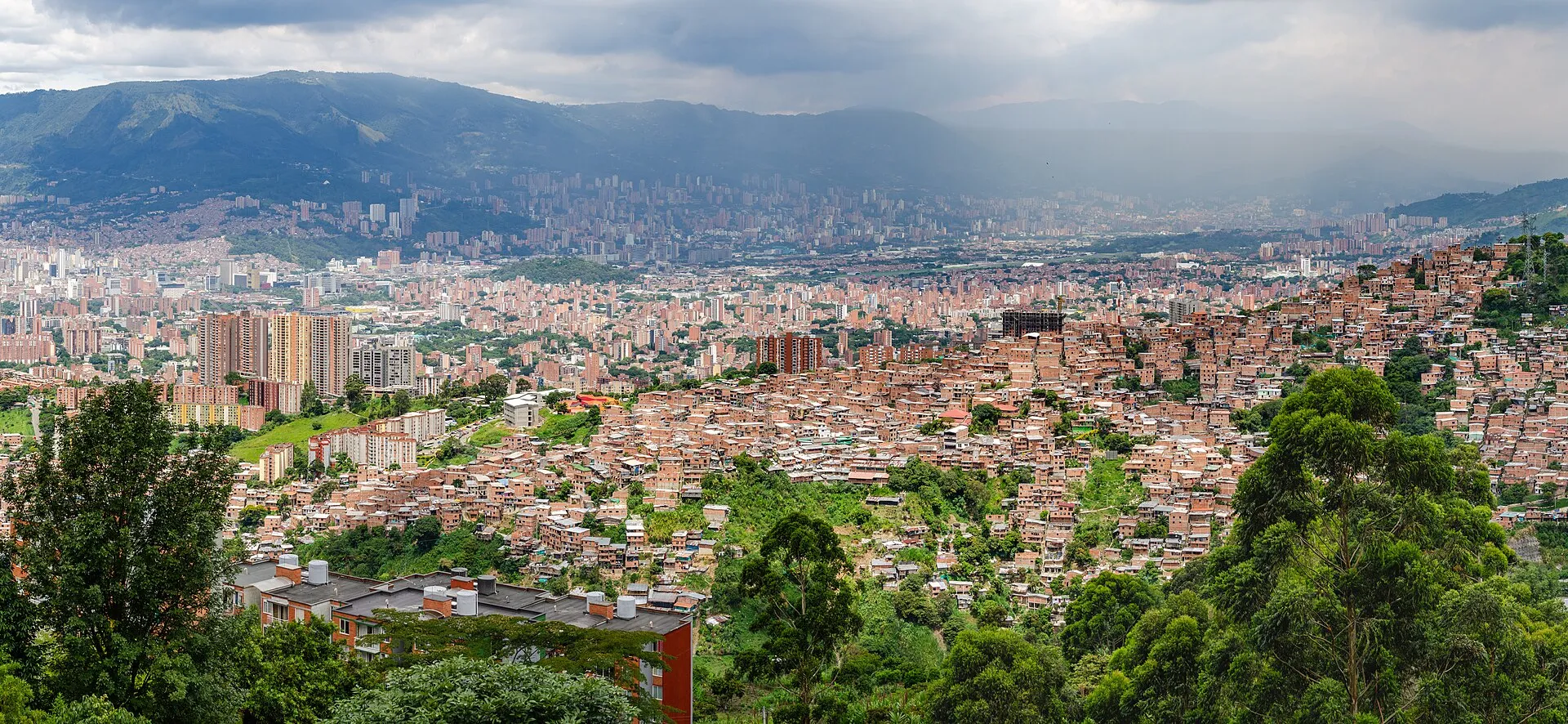
The city you would be paying in fills the Aburrá Valley, a trough in the Andes about 1,500 metres up, with the Medellín River running north through the middle. The metro, the only one in Colombia, follows the river along the valley floor. Where the slopes turn too steep for rails, the Metrocable takes over: gondola cabins, running since 2004, that link the hillside barrios to the trains. Before the first line opened, some residents of Santo Domingo Savio spent two and a half hours getting to work.
The altitude keeps the average near 22°C all year, which is why Medellín calls itself the city of eternal spring, and one reason remote workers stay for months rather than weeks, in El Poblado on the south-eastern slope or in Laureles across the river to the west. A stay of months is when the question of doctors stops being hypothetical. Finding an English-speaking doctor in Medellín is the easy part. The harder part is that word at the desk.
On a tourist stamp you can join neither Colombia's health insurance system, the EPS, nor the private plans above it, so every visit is particular and travel insurance is your only safety net. A visa of more than three months changes that: the ID card that comes with it opens an EPS from about $66 a month, with no health questions, and prepagada on top. And in an emergency, a hospital must stabilise you whether or not you can pay.
| Video consultation, English-first services | $63 to $100 |
|---|---|
| Office visit, 30 minutes | $150 |
| Home visit, 45 minutes | $95 to $225 |
| Internal medicine specialist, by video | $105 |
| Minimum wage, 2026 | $547 a month |
| EPS contribution, self-employed, at the minimum | about $68 a month |
| Nomad visa income floor | about $1,640 a month |
| Visa-exempt stay | 90 days, up to 180 a year |
| Register a visa of over 3 months | within 15 days |
| Emergency number | 123 |
Consultation prices: the published rates of two English-language doctor services in our Medellín directory, September 2026. EPS and visa figures: computed from Colombia's 2026 minimum wage and the rules below. Prices are in US dollars at Colombia's official TRM exchange rate of COP 3,329.61 to the dollar on 25 September 2026.
Where the English-speaking doctors are
The most reliable map is a government one. The UK Foreign Office keeps a list of medical facilities in Colombia with a column for whether the staff speak English, and in Medellín it names three hospitals. Two are private and marked Yes: the Hospital Pablo Tobón Uribe, whose main campus is in Robledo, west of the river, and the Clínica Medellín, whose El Poblado tower stands on Calle 7. The public Hospital General de Medellín is marked Some.
Our directory of English-speaking doctors in Medellín starts from that list and adds providers who state their languages themselves, six entries in all, each card naming the source of its language claim.
Six sounds thin for a city of 2.4 million, and it is thin on purpose: it counts doctors whose working language a published source confirms, not every doctor who may speak some English. For a wider net, the doctors we list across Colombia add 13 more, seven of them in Bogotá and every one of those from an official list.
What paying particular costs
The clearest prices come from the English-first services in our directory, because they sell to foreigners and publish their rates, set out in the table above. The spread between them is wide. The dearer one charges in dollars and asks $225 for a 45-minute home visit; the other prices in pesos and comes to less than half that for the same length of visit.
A home visit is the version that suits a newcomer with a fever, and the cheaper service sends its doctors to flats in El Poblado and Laureles, the two districts nomads choose most often. They are very different places to live.
El Poblado climbs the valley's south-eastern side from about 1,540 metres to over 2,000, its office towers lined up along the Milla de Oro and its nights centred on Parque Lleras; several of its barrios, Provenza and Manila among them, keep the names of the 19th-century farms they replaced. Laureles is quieter, laid out by the architect Pedro Nel Gómez in a radial pattern unlike the rest of the city, with metro Line B stopping at Estadio and Floresta.
Treat both services as the top of the market for a routine visit. The large hospitals publish no consultation prices and quote on request, and the Hospital Pablo Tobón Uribe's international office asks for payment in full before any procedure, warning that the final invoice can differ from the estimate. Get any quote larger than a consultation in writing.
EPS, IPS and the card that opens them
Every Colombian alternative to paying particular runs through an EPS, an Entidad Promotora de Salud. The EPS is the insurer: you enrol with one, it collects your contributions and it decides which clinics you use. Those clinics are the IPS, the Instituciones Prestadoras de Servicios de Salud, meaning the hospitals, practices and laboratories that treat you. A member is covered by the national benefits plan, from preventive care to high-complexity treatment, and pays moderating fees and co-payments along the way.
A remote worker belongs in the contributory regime, the one for people who pay: employees, pensioners and the self-employed. The subsidised regime is means-tested and was not built for an income from abroad.
The catch for an English speaker is the network. An EPS sends you to the IPS it has contracted, so you cannot choose a doctor for their English unless that doctor happens to work inside it.
The door to all of this is a card, the cédula de extranjería. Everyone aged 7 or over who holds a visa valid for more than three months must request a cédula and register with Migración Colombia within 15 days of arrival or of the visa being issued. A tourist on an entry stamp holds no visa, and so gets no card.
The health rules close the loop. For foreigners, the enrolment documents are the cédula, a passport, a diplomatic card or a safe-conduct pass, "as applicable", and the Ministry of Health's enrolment guide for migrants accepts a passport only for children under 7. For an adult, the cédula is what works.
Self-employed residents earning at least one minimum wage are placed in the contributory regime by law. So the order is fixed: a visa of over three months, registration inside 15 days, the cédula, then an EPS of your choice. On a 90-day stamp, none of it is open.
What an EPS costs, and what it cannot ask
The contribution is 12.5 percent of your declared income, and that base never falls below the minimum wage. An employee splits it with the employer; a self-employed member pays all of it, monthly in arrears through the PILA contributions form. At the minimum that is about $68 a month, rising with what you declare.
Two rules make the EPS worth having. It may not ask about your health as a condition of enrolment, so nothing you already live with is excluded, and your cover begins on the day you enrol. For a nomad with a chronic condition, that is the real difference between the EPS and prepagada.
Prepagada: the private layer on top
Medicina prepagada is private cover sold by prepaid-medicine companies. It opens the private clinics and specialists in the company's own network, which is where a foreigner with a cédula finds the widest choice of English-speaking doctors. It is the third word on that hospital booking page.
It is not an alternative to the EPS. The plans can be sold or renewed only to people enrolled in the contributory regime, as contributors or as beneficiaries. On a tourist stamp, then, the door is shut twice: no cédula means no EPS, and no EPS means no prepagada.
Where the two differ, it matters. A prepagada company may run an entry examination and exclude conditions you already have. At renewal it cannot add exclusions for illnesses that began after you signed, and it must renew unless you breach the contract. Once you hold both, you choose at each visit whether to use the EPS or the plan, and the company cannot make you try the EPS first.
Insurance on a stamp, and the policy the nomad visa demands
On an entry stamp, your own insurance is the whole plan. Visa-exempt nationals may stay 90 days, extendable to 180 in a calendar year, and for all of it Colombian cover stays closed. Carry insurance for local treatment and for medical evacuation, and call the insurer as soon as a doctor refers you to a hospital.
Match the policy to your weekends. Line L of the Metrocable climbs the eastern slopes from Santo Domingo in about 15 minutes to Parque Arví, a 16,000-hectare reserve with forest trails and a market beside the gondola station. Across the valley, Line J climbs into Comuna 13, where outdoor escalators have replaced more than 350 steps since 2011. A policy that covers a sprained ankle on a trail is worth more here than one that only covers a hospital bed.
The digital nomad visa, the V Nómada Digital, turns insurance into a condition: a health policy covering Colombian territory against accident, illness, maternity, disability, hospitalisation, death and repatriation, for the whole planned stay. The wording names seven risks and the territory, not an insurer, so check your policy against each one before you apply.
The same visa asks for income of three minimum wages over the last three months, about $1,640 a month at the 2026 wage, and runs for up to two years. Issued for more than three months, it brings the cédula, and with it the EPS. Our nomad visa finder sets Colombia's rule beside the other programmes.
Need a name before you land?
Our Medellín directory lists doctors, dentists and lawyers by the language they work in, and every card links the source that states it.
Browse Medellín services →Urgencias, and the quieter door beside it
Urgencias, the emergency department, is the one place where being particular does not matter at first. Every public and private provider must give initial emergency care to anyone, regardless of ability to pay, with no contract or prior order. The rule is Article 168 of Ley 100 of 1993, worth naming if a desk hesitates, and your insurance may be checked only after triage, never as a reason to delay that first care.
Triage sorts arrivals into five categories, and categories IV and V, conditions with no evident risk to life or limb, wait longest. For them the Ministry of Health points to outpatient care instead, including consulta prioritaria, a priority appointment. A fever, an ear infection or a sprain belongs there, or on a video call, not at the back of an urgencias queue.
Know where the right ends. "Initial" means stabilising you, a first diagnosis and a decision on where you go next. Everything after that is billed, to you or to your insurer, and an English-speaking doctor on the night is not guaranteed. The Hospital General de Medellín, the public hospital on the Foreign Office list, runs a high-complexity emergency department open 24 hours a day, every day of the year.
For an ambulance, call 123 and ask for one. Have your address ready in Spanish, in the Calle and Carrera numbers that Medellín addresses use, carry your passport or cédula, because the hospital registers you by document number, and save your insurer's emergency line in your phone before you ever need it.
One case works differently. Hurt in a traffic accident, as a pedestrian or a passenger, and your treatment is billed to the SOAT of the vehicle involved, the compulsory accident insurance every motor vehicle must carry, from emergency care and surgery to medicines and rehabilitation. Note the plate and the SOAT details at the scene if you can.
Droguerías and the Spanish prescription
Pharmacies are droguerías, marked with a cross, and most of them deliver, which counts for a lot on a steep street in El Poblado. The rule that matters is printed on the box: anything labelled "Venta bajo fórmula médica" is sold only against a prescription. The person at the counter must ask for one, and may neither recommend medicines nor swap the one prescribed.
A valid prescription has a set form: written in Spanish, using the generic name, with doses in the metric system and the prescriber's name, signature and professional registration number. One from home does not meet it, so you may need a local doctor's prescription for some medicines. For a repeat, bring the packaging or your home prescription, so the doctor can write the generic name.
Controlled medicines, the medicamentos de control especial, follow a stricter regime. If you take one, bring enough for the whole stay in its original packaging, in your carry-on, with a copy of the prescription.
How to check a doctor before you trust one
Colombia keeps one national register of licensed health workers, the ReTHUS, the Registro Único Nacional del Talento Humano en Salud. Doctors, dentists, nurses and other professionals must be inscribed in it to practise, and it records the sanctions handed down by the medical ethics tribunals.
Its public search, on the Ministry of Health's SISPRO portal, takes an identity number or a name and shows whether the person is registered, for which profession, and any sanction. Run it for any doctor you found through an advert or a social media group.
The registration number must be printed on every prescription, so the paper in your hand already gives you something to search. And a foreign-trained doctor must have the degree recognised, the convalidación, before registering, so they should still appear.
Why English clusters where it does
English in Medellín's medicine follows the patients who fly in. The Hospital Pablo Tobón Uribe's international office has served them for more than 20 years, advertises multilingual staff and lists check-ups, cosmetic and bariatric surgery, transplants and oncology among its services. The Clínica Medellín takes international enquiries through a form written in both Spanish and English.
Dentistry shows the pattern more sharply. Half of the eight entries in our list of English-speaking dentists in Medellín come from a directory of clinics that treat international patients. Where a clinic sells treatment to people from abroad, English is part of the product.
That office counts as international anyone who has lived abroad for the past six months, or who lives in Colombia with international medical insurance, which covers a nomad with an international policy. At the public hospital, where English is marked Some, bring a translation app or a Spanish speaker.
What to do, in the order you need it
Say you land in August, for the Feria de las Flores, when the silleteros of Santa Elena carry flower arrangements through the city on their backs. For a 90-day stay you are particular throughout: buy insurance with evacuation cover, save 123 and your insurer's line, and note the two private hospitals the Foreign Office marks Yes.
If Medellín turns into a base, the aim is to stop being particular. Get a visa of more than three months, register for the cédula inside 15 days, join an EPS with no health questions asked, then add prepagada if you want a private network with more English in it. Until then, the prices in the table are what particular costs, and a video call is the cheapest way to start.
For everything beyond the doctor, from neighbourhoods and rents to safety and the visa, our Medellín city guide puts it on one page. Still choosing between bases? Our Medellín vs Chiang Mai comparison sets the two side by side on cost, visas and daily life.
Find a doctor who speaks your language
The hospitals on the Foreign Office list and the services that visit flats in El Poblado and Laureles, each with the source for its languages.
Browse doctors in Medellín →Frequently Asked Questions
How do I find an English-speaking doctor in Medellín?
Start with the UK Foreign Office list of medical facilities in Colombia, which marks English as Yes at the Hospital Pablo Tobón Uribe and the Clínica Medellín, and Some at the public Hospital General. Our Medellín doctors directory adds services that state their languages themselves, each with its source.
What does "particular" mean at a Colombian hospital?
It means paying for your care yourself, with no EPS, prepagada plan or policy behind you. It is how a foreigner on a tourist stamp sees a doctor in Medellín, and the bill is then claimed from travel insurance.
How much does an English-speaking doctor cost in Medellín?
The English-first services publish their rates: a video consultation costs $63 to $100, an office visit $150 and a home visit $95 to $225, as of September 2026. The large hospitals quote private consultation prices on request.
Can a tourist join an EPS in Medellín?
No. Adult foreigners enrol with a cédula de extranjería, which comes only with a visa valid for more than three months. Prepagada is closed too, because it can be sold only to people already enrolled in the contributory regime.
What health insurance does Colombia's digital nomad visa require?
A health policy covering Colombian territory against accident, illness, maternity, disability, hospitalisation, death and repatriation, for the whole planned stay. The visa also requires income of three minimum wages, about $1,640 a month in 2026.
Will a Medellín hospital treat me in an emergency without insurance?
Yes. Every public and private provider must give initial emergency care regardless of ability to pay, and insurance may be checked only after triage. That covers stabilisation and a first diagnosis; treatment after that is billed to you or your insurer.
How can I check that a doctor in Medellín is licensed?
Search the ReTHUS, Colombia's national register of health professionals, on the Ministry of Health's SISPRO portal by identity number or by name. It shows whether the person is registered to practise and any sanction from the ethics tribunals.


