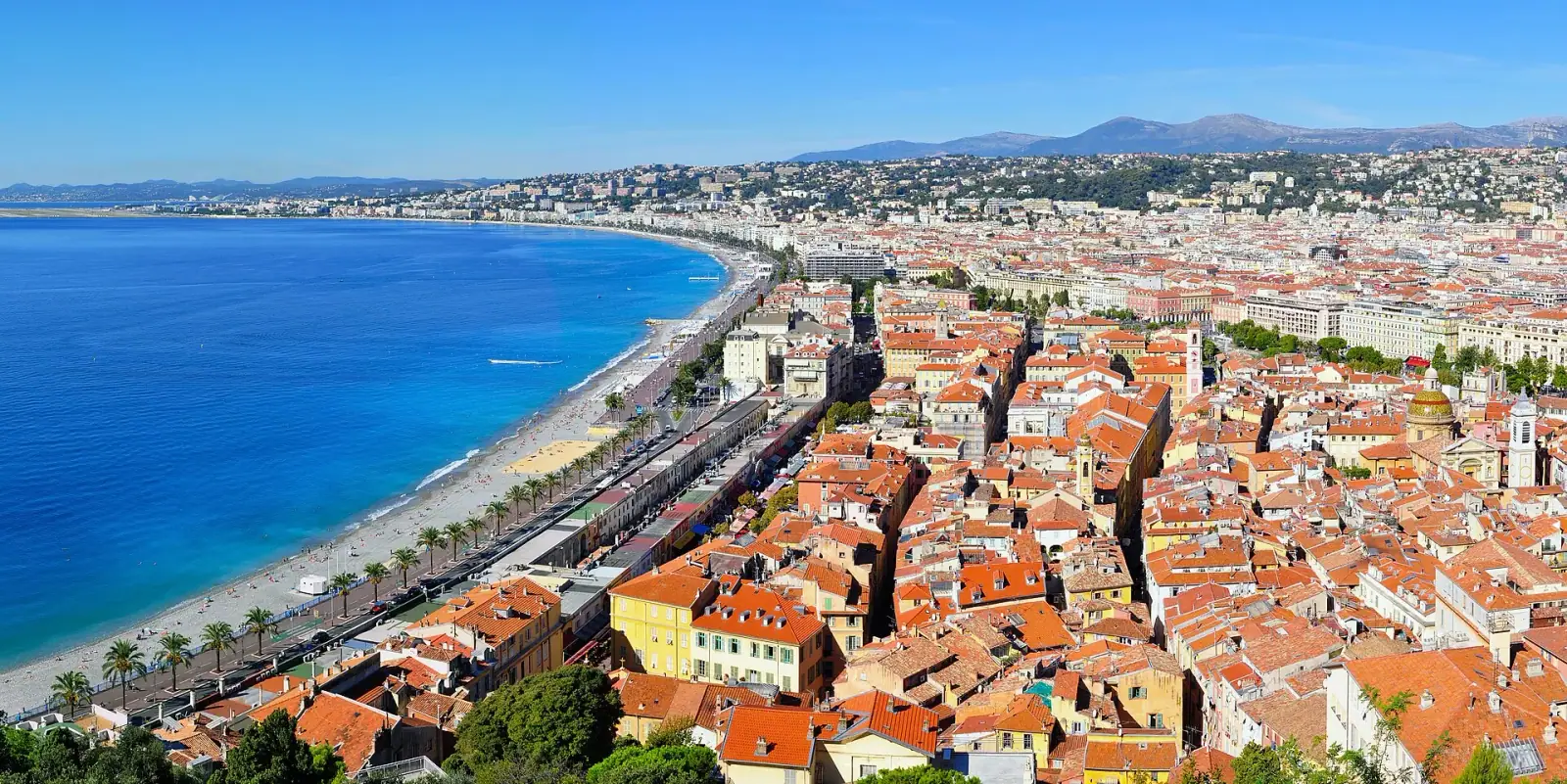
 Nice
You could read a dozen comparisons of Nice and Marseille without learning what a Tuesday is like. So take one, with a job, a call at ten, and no plans to see a single museum.
8:00, on the way to a desk
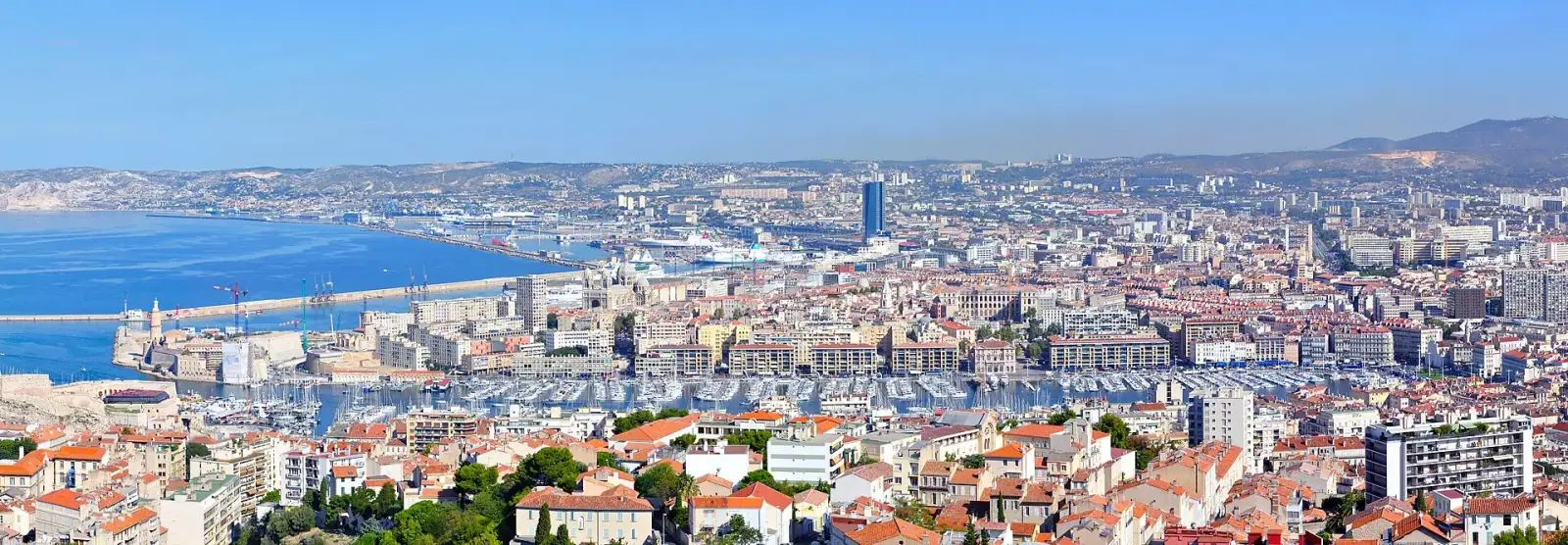
In Marseille, the fish market is still held on the Quai des Belges, at the head of the Vieux-Port, and you could walk past it to NOW Coworking, a former sail loft on the Quai de Rive Neuve with a terrace over the boats. In Nice, the flower stalls of the Cours Saleya are going up, and Le LABO on Rue du Congrès is a few minutes from the beach. Both walks beat a commute. Nice is the tidier of the two, with UNESCO status for its Riviera winter-resort streets since 2021. Marseille, with about 886,000 people against 358,000, simply has more going on at that hour, and more of it is none of your business.
10:00, the call
Connectivity should not worry you in either place, and in Marseille it is almost a joke. Around 16 undersea cables land there, and one of the data centres that handles them is in a German submarine base from 1943. Clients are the bigger difference. Sophia Antipolis, the technology park near Antibes, gives the Nice side a cluster of software and biotech firms within reach, and that helps if you want local work as well as remote work. Marseille's economy leans on its port, and you will need French for most local work.
13:00, lunch
Both lunches are chickpea flour, which pleases us. Nice has socca, the thin pancake from the Ligurian tradition, cut up and eaten hot in the old town. Marseille has panisse, from the same flour, and the market streets of Noailles around it, where North Africa and the Mediterranean meet. A sit-down menu comes to around $14 in Marseille and $15 to $21 in Nice, so the difference between these cities is not found at the lunch table.
16:00, you have to go somewhere
Here Nice wins easily. Tram line 2 runs from the port to the airport in about 26 minutes, for a pass of around $23 a month, and the airport is the third busiest in France, with 15.2 million passengers in 2025 and flights to London and much of Europe. Marseille's airport is smaller and further out, about 30 minutes on the L91 bus at $11. Its strength is the TGV, which reaches Paris in about three hours, and its monthly pass runs nearer $57.
The two cities share a coast, yet the train between them takes from about two and a half hours to three. Since June 2025 Transdev has run it, the first time a French region has handed a service to a non-SNCF operator. Do not plan on commuting between them.
18:30, after work
This is where you find out what you are paying for. In Nice, you could swim off the pebbles of the Baie des Anges and walk up Castle Hill for the view. It is hard to beat, and the winter days are a touch milder. Marseille's answer is the Calanques, the only national park inside the limits of a big French city, 520 square kilometres, most of it sea, with limestone inlets along the shore. It also gets more sun, about 2,900 hours a year against 2,760, the most of any city in France. That comes with the mistral, a cold, dry wind that clears the sky and can blow for days in winter and spring.
22:00, walking home
Marseille's bad name has a basis, and you should look at it. Drug-linked killings reached 49 in 2023 and fell to 24 in 2024. The city is deeply split between a poor north and a richer south, and you will have little reason to be in the northern estates, but petty theft is common everywhere. Choose your street with care, the Cours Julien side rather than whatever is cheapest near the station. Nice asks far less of that thinking, and that is much of what its price buys.
That price is large. We put a month at around $3,800 in Nice and $2,700 in Marseille. Local tenants are much closer, about $980 against $810 for a one-bedroom, and everything else costs them the same, so most of the $1,100 is the premium on a furnished central flat in a resort.
Unless you fly every fortnight or cannot face learning French, we would take that $1,100 and go to Marseille.
 United States
 United Kingdom
 Germany
 Canada
 Australia
 India