
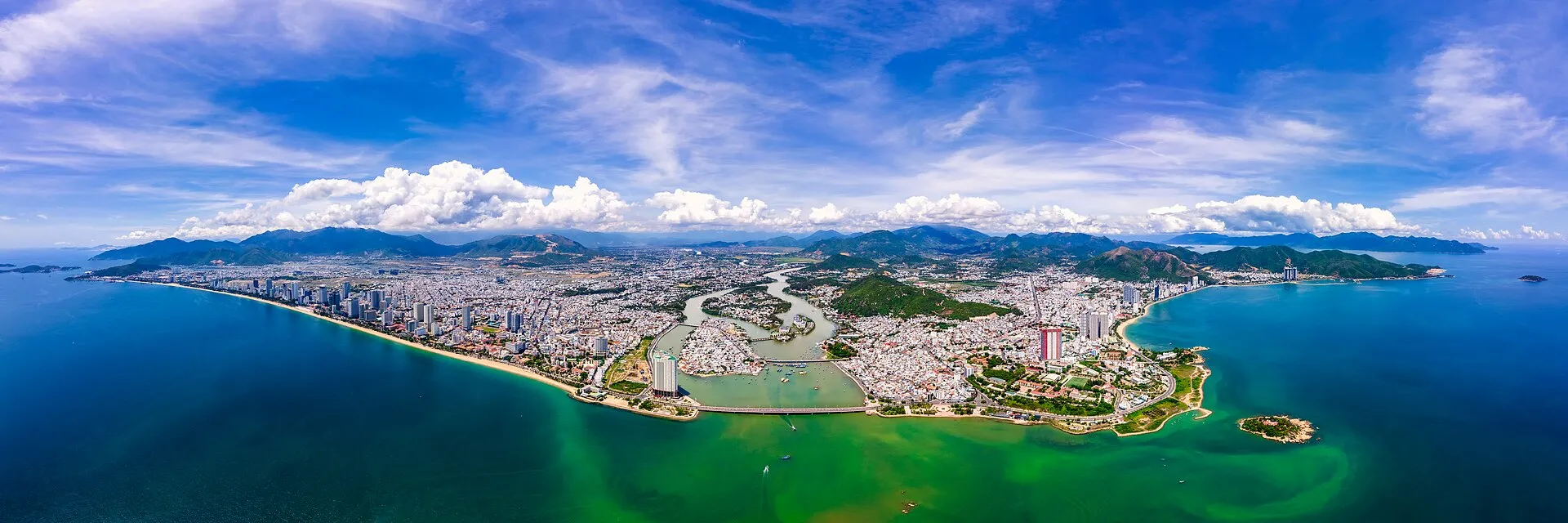
 Da Nang
Pick Da Nang. At the same money, around $1,400 a month in either city on our estimate, it gives you an airport beside the city centre, My Khe, a beach that changes its name several times over nearly 40 kilometres of sand down to Hoi An, and An Thuong, a few blocks of cafes and gyms behind the sand where you will meet people who also have a laptop. On a Saturday you can watch the 666 metre Dragon Bridge breathe fire at nine in the evening, ride up Son Tra to look for red-shanked doucs under a 67 metre statue of Guanyin, or fill the tank and take the Hai Van Pass. A bowl of mi quang is about $1.50.
That is the verdict. It is also what almost everyone says, so it deserves a proper attack.
The rain
Da Nang's weakest point is October, when about 726 millimetres fall on average, and sometimes far more. In late October 2025 parts of central Vietnam took over a metre of rain in 24 hours. The Hoi An old town went under, with some houses flooded to the roof, and the Da Nang authorities counted 12 dead and four missing, along with widespread evacuations. Hoi An has been a ward of Da Nang since the merger of July 2025, so you can no longer treat that as someone else's problem. Coworking spaces sometimes lose power in those weeks, and a remote worker with a deadline ought to be elsewhere.
Nha Trang has a shorter and lighter season. Its worst month, November, averages about 390 millimetres, little more than half of Da Nang's peak. It is hardly immune: floods and landslides killed ten people in Khanh Hoa province a few weeks after the Hoi An flood. Power cuts there are unusual, however, and the season is over sooner.
The winter and the water
Da Nang in January is cooler than the postcards suggest, about 25°C by day and 20°C at night. Nha Trang is a couple of degrees warmer at that time of year, and we think it has the better swimming, with a curved six-kilometre beach on a bay full of islands. From February to May the sea there is at its calmest. With about two dozen dive shops, it is Vietnam's obvious choice if you want to go under the water, and a two-dive trip costs about $45. You could walk from the Tran Phu seafront to the Po Nagar towers, four brick Cham towers built between the 7th and 12th centuries, in about 25 minutes, and take the cable car across to the island of Vinpearl on another day.
It also has a real town behind its hotels. A few streets inland from the beach you are back among local markets and cheap seafood, and a day pass at Stockholm Bistro, the coworking favourite, costs about $5.50. For someone who works alone, likes routines and wants to swim every day from January to August, this is a stronger offer than Da Nang's reputation allows.
Why Da Nang still wins
Three things bring us back, and none is about the beach. The first is Cam Ranh airport, about 30 kilometres south of Nha Trang, which means a drive of 45 to 60 minutes and a Grab fare of $10 or so each way. If you fly often, that adds up. The second is the tourist strip itself. Russians are the largest group of foreign visitors, Russian signs outnumber English ones along Tran Phu, and the high-rise hotels are aimed at short holidays, so the friends you make there will tend to leave soon after you meet them. The third is what you can do with a free weekend, where Da Nang simply has more within reach.
The rain objection has a clean answer, which is to leave. Give up Da Nang from late September to December, go somewhere else for those months, and you lose very little. Hoi An is an easy add-on for the rest of the year.
If this still leaves you undecided, spend a fortnight in Da Nang during a dry month and take the train south. It takes between nine and eleven hours. Then see, by your second week on Tran Phu, how much you miss having somebody to eat with.
 United States
 United Kingdom
 Germany
 Canada
 Australia
 India