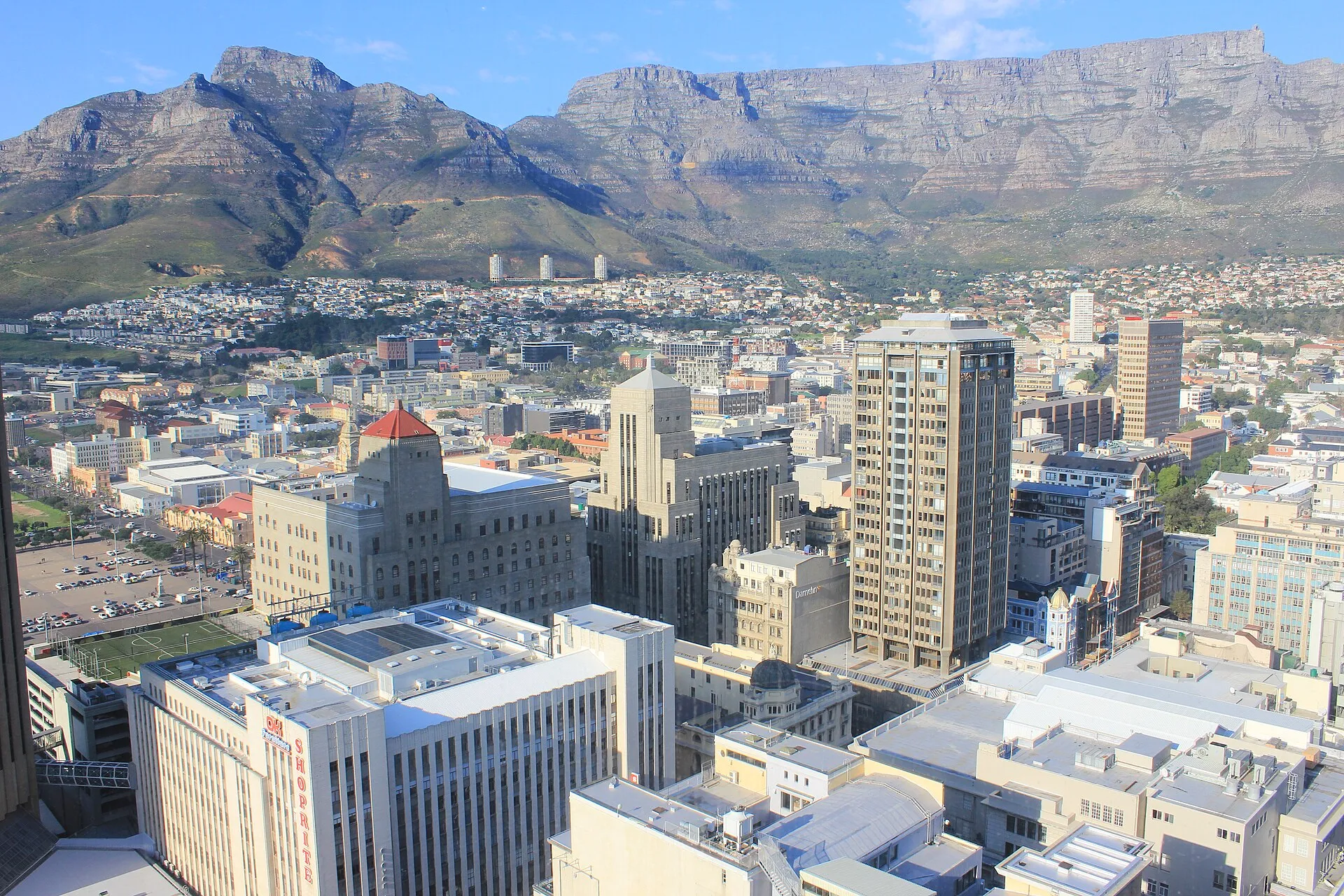

 Cape Town
 Nairobi
A tourist season is a useful thing to subtract. Take the visitors out of each of these cities, say in the third week of July, and see who is still there, because those are the people you will be living among.
Cape Town in July
The record summer crowd of over 2.4 million visitors has gone home. Cold fronts come in off the Atlantic with heavy rain and strong north-westerlies, and a day peaks at about 18°C. Camps Bay, in the pictures, is a beach bar at sunset. In July it is an excellent view of the weather.
Who stays? Mostly people who came for the place and found a way to earn in it. Tech people, in what the city likes to call Africa's main hub, with its fintech startups and a sector growing about 8 percent in 2025. Film crews, since this is one of the great production centres of the Southern Hemisphere, based around the Cape Town Film Studios. Then there are the South Africans who moved to the coast from inland during the pandemic, a move the country calls semigration. You could meet any of them at the Old Biscuit Mill in Woodstock on a Saturday.
It is a likeable crowd, and it has one big limit. Cape Town is a divided city in a way you will see from the highway. About 60 percent of its residents live in townships and informal settlements far from the centre, the violence that gives the metro its grim murder count of 2,998 in 2022 to 2023 is concentrated in particular suburbs of the Cape Flats and you could easily spend a year in the City Bowl and never properly meet the majority. By July the whales are off Hermanus, 115 kilometres away, and your weekends can be lovely without any of this troubling you. That is the bit to think about.
Nairobi in July
Nairobi has much less to subtract. It is a safari gateway, which means visitors tend to pass through on their way to somewhere else. So the city you will meet is much the same in any month, a working capital with a median age of about 23, and it does not need you at all.
The foreigners are here for jobs, and that gives the place its peculiar social map. Gigiri, next to Karura Forest, holds the UN's official headquarters in Africa and the global headquarters of both UN Environment and UN-Habitat, with the American embassy across the road. Around them are the diplomats, aid workers and regional managers of multinationals such as Google, IBM and Coca-Cola, which moved their African headquarters here in 2007.
As a remote worker, you will be unusual, and that cuts two ways. You could find yourself on a Friday in Westlands or Kilimani talking to someone who runs logistics for half of East Africa, or a founder from the iHub crowd, and the conversation will be about work, in English, without the nomad small talk. But you will have to work to find your people, since there is no easy crowd of laptop strangers waiting for you. No other capital can offer the same Saturday: Nairobi National Park, 7 kilometres from the centre, with black rhino and the skyline behind them. In July and August, when the land dries out, the herds move into it. The month itself is cool, at 24°C by day and 12°C at night, and dry, the reverse of Cape Town.
Your problem here will be the road. A five-kilometre trip at rush hour can take 45 minutes. Bolt or Uber after dark is the normal, sensible habit. And Kenya votes on 10 August 2027, after the youth-led protests over the 2024 Finance Bill, so a long lease across that date deserves some thought.
Money and permits
By our estimate a month in Nairobi runs about $1,600, and one in Cape Town about $2,000. Kenya claws that advantage back at the border, though. Its Class N permit asks for about $4,580 a month from outside the country, plus a $1,000 yearly fee, while South Africa's visa asks about $3,280 and runs for up to three years. Our nomad visa page has both. So on $4,000 a month, you are choosing Cape Town, like it or not.
Above that line, ask yourself who you want to be sitting next to in the rain. In Cape Town it will be someone who moved for the mountain. In Nairobi it will be someone who moved for the work. We would take the mountain for six months, and our Cape Town guide will get you set up. But which of those two people would you still be having dinner with in year two?
 United States
 United Kingdom
 Germany
 Canada
 Australia
 India