 Santa Teresa
Nosara was laid out to stay small. It worked, and that is why a month there costs about $2,300 on our estimate. Santa Teresa had no such design, has been filling up for years with little control, and comes in near $1,400. You would expect the protected town to be the easier one to live in. For someone working from a laptop, we think the unplanned one is.
How Nosara got its shape
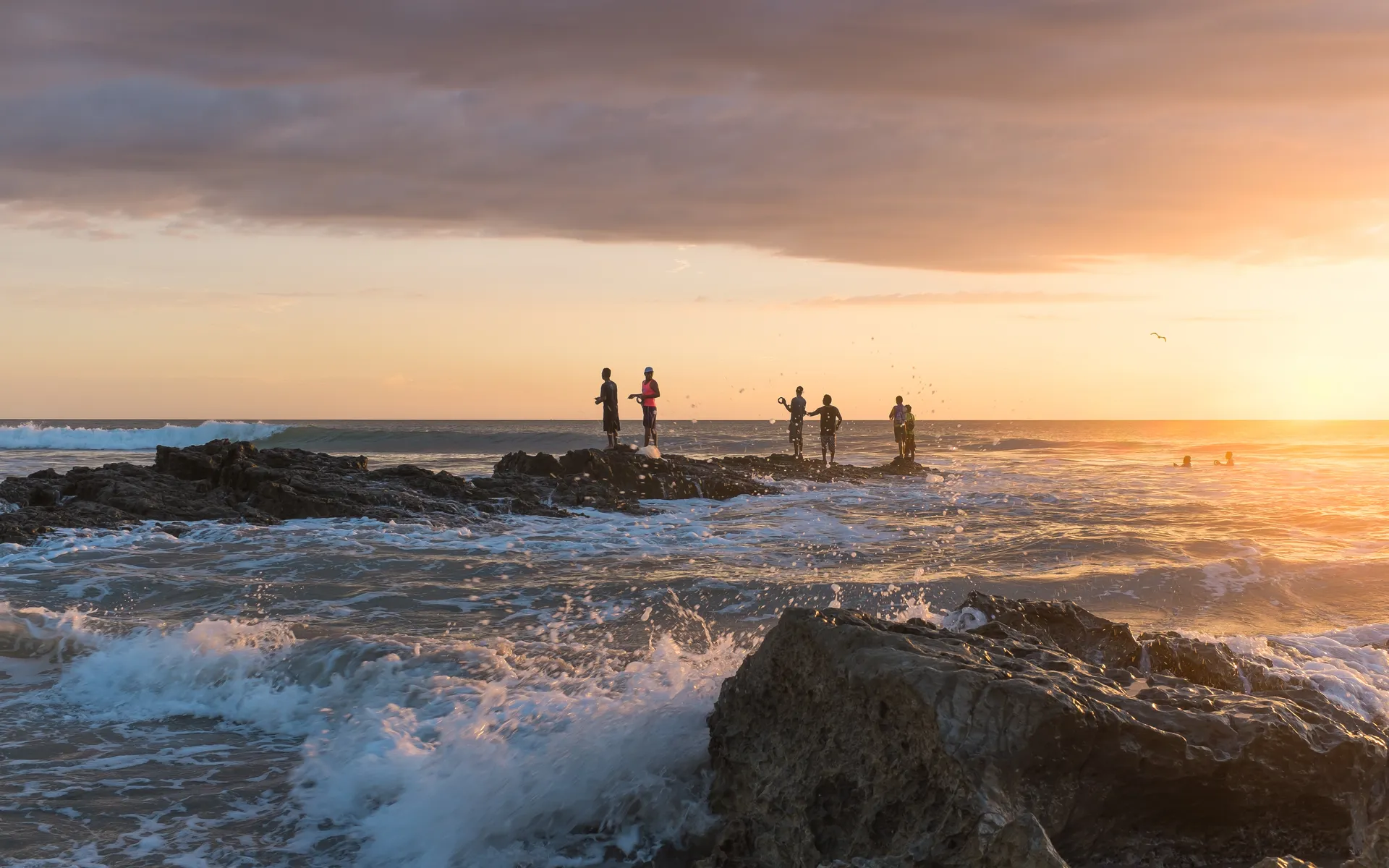
Around 1970 an American developer, Alan Hutchinson, bought more than 1,100 hectares of cattle ranch behind these beaches, intending a low-density community inside the forest. The services did not arrive as planned, so in 1975 the residents formed a civic association to help get electricity and roads built and to start replanting trees at Playa Guiones. It now protects more than 652 acres of forest, and most of the beachfront lies inside the Ostional Wildlife Refuge, a major nesting ground for olive ridley turtles. Walk onto Guiones today and you get a long open beach with the houses kept back in the trees.
People noticed. The district went from 2,875 residents in 2000 to 9,412 in 2022, so a one-bedroom near that beach starts around $900 and rentals vanish in the dry season. Low density charges you daily as well. Everything is a few kilometres apart on dirt, almost everyone rents a quad or a small 4x4, and transport alone comes to about $200 a month.
How Santa Teresa grew
This town is one long coastal road, with Santa Teresa running north from the junction at Playa Carmen and Mal País running south. Reporting in 2023 found no comprehensive zoning plan, only a coastal one reaching about 150 metres inland, and permitted construction that nearly tripled between 2018 and 2020. Paving the road has been fought over for more than a decade, some residents wanting relief from the dust and others dreading a second Tamarindo.
The irony sits at the end of that road. Just past Mal País is Cabo Blanco, which Nicolás Wessberg and Karen Mogensen bought in 1963 and which became the first protected area in the country.
What each one does to your working day
Disorder turns out to be convenient. Stay near Playa Carmen and the supermarkets and banks are on foot, the coworking spaces and cafés are strung along one road, and a bicycle covers the rest, though your laundry will suffer in the dry season. In Nosara you could take a yoga class at seven, surf the gentle Guiones break, ride a quad to a desk at The Wave and be asleep early, since the evenings are mostly dinners and a few beach bars.
Nosara does have the easier way in: an airstrip 45 minutes from San José. Santa Teresa means the ferry from Puntarenas to Paquera and another hour of road, or a short flight to Tambor and a transfer. The nomad visa is the same for both, at $3,000 a month.
Where we would start
Start in Santa Teresa, towards the calmer Playa Hermosa end if the main strip feels busy, and keep the $900 a month. Nosara makes more sense later, for someone who already knows this coast is home.
One warning. Before you sign a long lease in Santa Teresa, walk the plots on either side of the house. In a town without a plan, nobody else is going to tell you what is coming next door.
 United States
 United Kingdom
 Germany
 Canada
 Australia
 India