 Quito
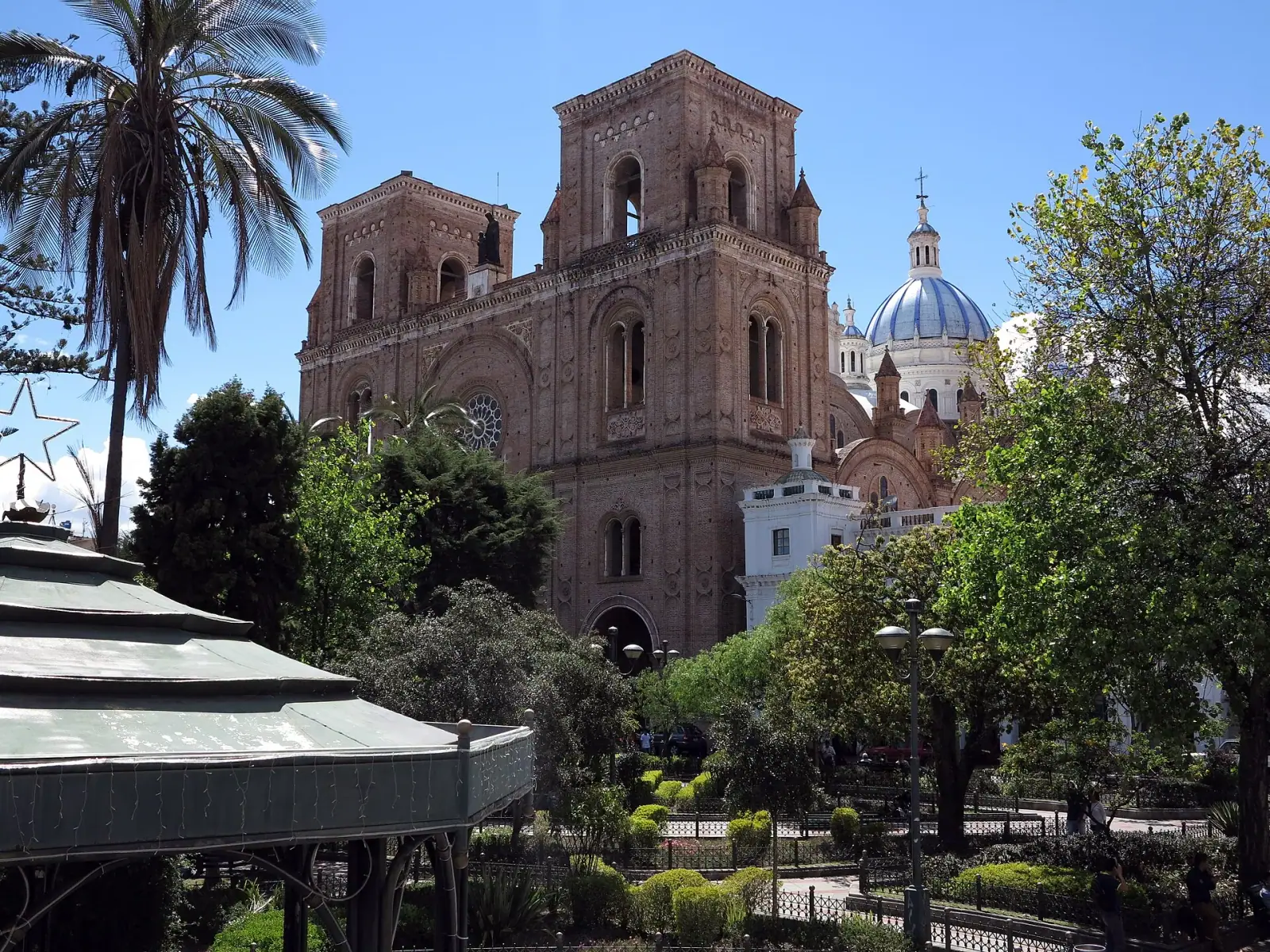
Look at the towers on Cuenca's New Cathedral and something seems off. They stop short. Juan Bautista Stiehle, the German friar who designed the building in the 1880s, got his calculations wrong, and raising the towers to the planned height would have overloaded the foundations. So they were left as stumps, and nobody seems to have minded. The three great domes behind them, in blue and white glazed tile from Czechoslovakia, became the picture on every postcard. When work started, the church was meant to hold 9,000 of the town's 10,000 people.
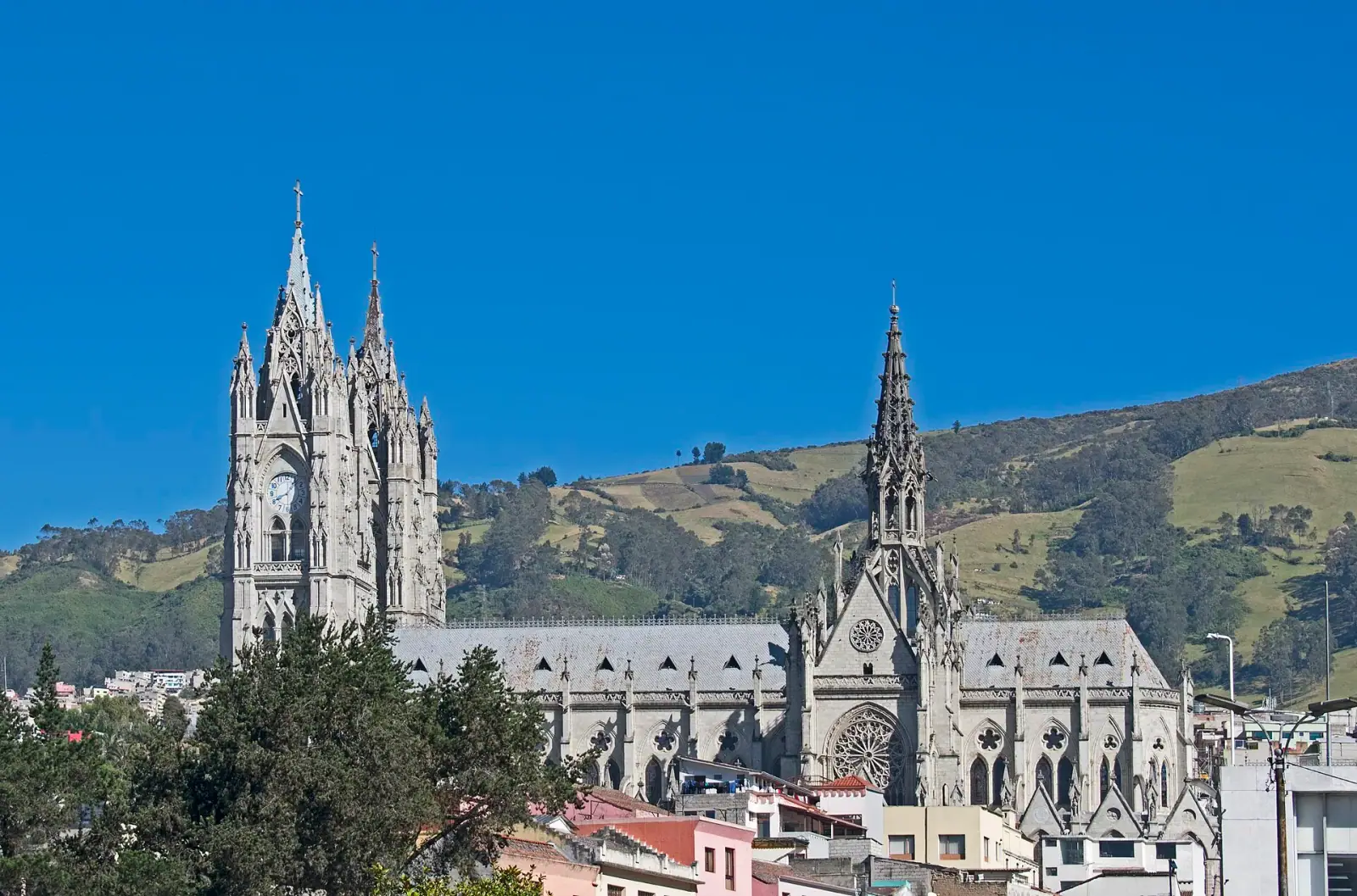
Quito's great church has a different story about not being finished. The Basílica del Voto Nacional took from 1892 until its consecration in 1988, and popular belief holds that the world ends on the day it is complete. In place of the usual European monsters, its gargoyles are Galápagos tortoises, blue-footed boobies, armadillos and caimans. For a small fee you can climb to a platform in its towers, which rise to about 83 metres, and that is the single most useful thing you can do before choosing between these cities.
What you can see from each
From the Basílica, you see the problem and the appeal of Quito at once. The city runs about 40 kilometres along a valley and at most 5 across, jammed against the active volcano Pichincha, with a 41-metre aluminium Virgin on the Panecillo in front of you. You will not walk that. Since December 2023 you have not had to crawl through it on buses either: the metro runs underground for 22.6 kilometres from Quitumbe to El Labrador, with one stop in the old town. La Floresta, with its cafés, cinema and IMPAQTO coworking, is the neighbourhood we would look at first. At about 2,850 metres, the sun can reach a UV index of 24 at midday, so wear a hat.
In Cuenca the scale of the 1880s has mostly held. From Parque Calderón in front of the cathedral you can reach most restaurants and markets on foot in under 20 minutes, the Tomebamba runs below the old houses of El Barranco, and a tram opened in 2020 for anything further. It sits a few hundred metres lower, and days are a degree or two warmer. Fibre at home is cheap and good, though café connections slow down at busy hours. The foreign community, at an estimated 4,000 to 6,000, skews older, and the evenings end early.
The figures that should decide it
Ecuador recorded 9,216 homicides in 2025, about 51 per 100,000 people, the worst year in its history. Most of that is on the coast. Quito counted 110 between January and 19 August 2026, down from 128 a year before, which by our arithmetic is well below the national rate. But it is not a calm city in the way it used to be. Pichincha was the only Andean province under the night curfew declared in May, 4,000 extra police and soldiers were announced for Quito in August, and the most common problem you will meet is still theft. Cuenca's rate for 2025 was reported at about 1.4 per 100,000.
The money does not pull you either way. A month comes to roughly $1,500 in Quito and $1,400 in Cuenca by our reckoning, and the nomad visa asks $1,446 a month in income wherever you live.
We lean to Cuenca, unless you work best surrounded by people your own age, or you fly often. Its airlines fly mainly to Quito. That turns out to be useful: you will probably pass through the capital anyway, so spend your first week there, climb the Basílica, then fly south and see whether those short towers feel like relief.
 United States
 United Kingdom
 Germany
 Canada
 Australia
 India