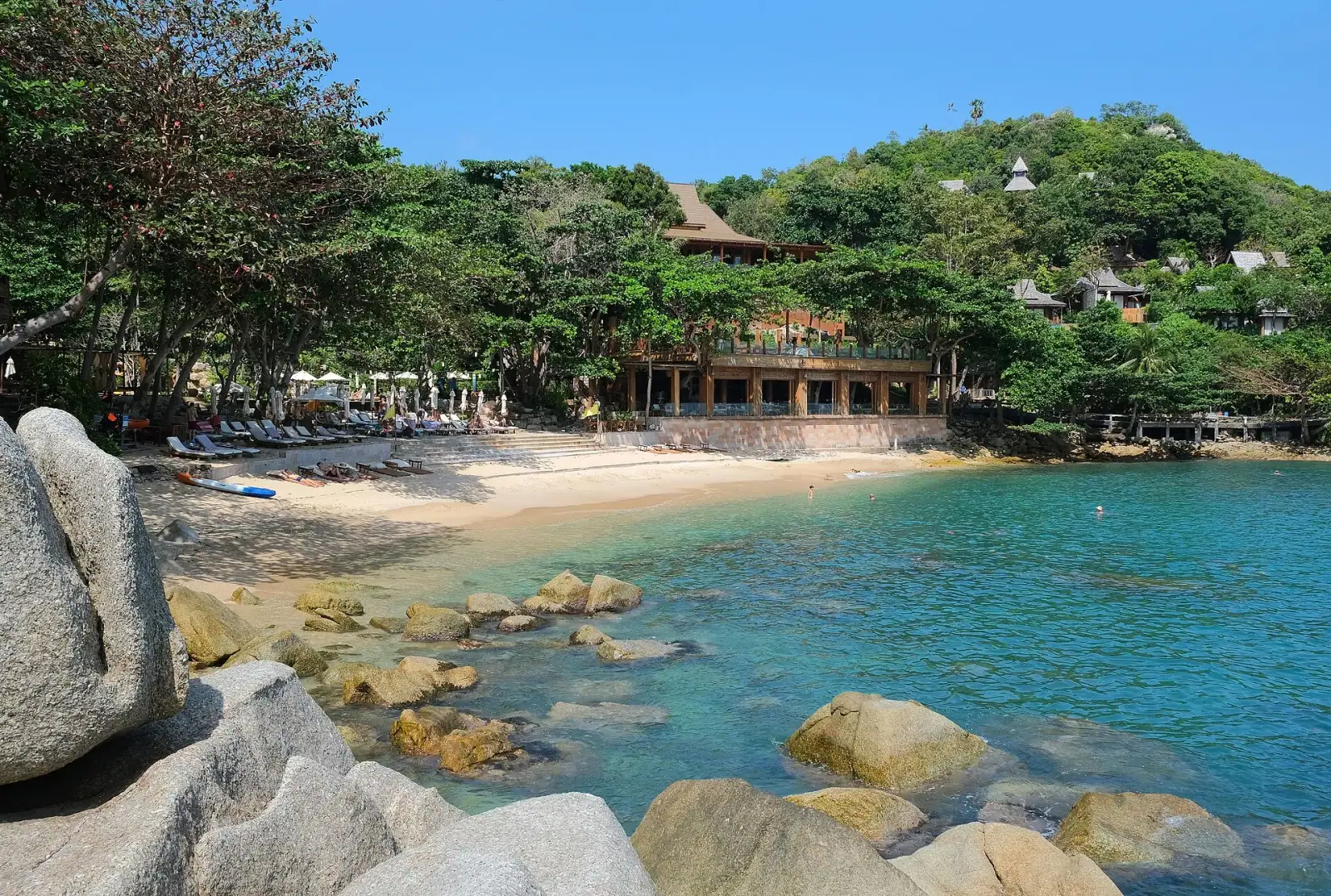

 Koh Phangan
On a scrap of land off Samui's north-east corner, joined to it by a short causeway, a 12-metre gold Buddha has sat since 1972 at the top of a staircase lined with naga serpents. It is the island's postcard. It is also, by chance, the most useful place to stand if you are trying to choose between these two islands, because everything that makes Koh Samui easy lies a few minutes behind you, and the boat to Koh Phangan leaves from the pier in front.
Looking inland from the statue
About three kilometres to the south is the airport. Bangkok Airways built it in the 1980s and still owns it, with an open-air terminal and flights to Bangkok close to hourly, as well as Singapore, Hong Kong and Kuala Lumpur. That ownership has a price, since one airline controls the mainland route: a one-way to Bangkok booked ahead runs to about $100 to $150.
Three kilometres west is Bophut, with the candlelit restaurants of Fisherman's Village, Bandon Hospital next to the Big C and Thai International Hospital close by. Bangkok Hospital Samui is on the ring road towards Chaweng. Five private hospitals serve an island of about 70,000 residents, and you can drive round all of it in a couple of hours. The island took 2.7 million tourists in 2018 and has built itself to match, for better and worse. You could live for a long time on the north coast, between Bophut and quiet Maenam, and rarely feel you were on a small island at all.
Looking across the water
Then there is the pier named after the statue. Boats leave it for Haad Rin, where 5,000 to 30,000 people turn up on full moon nights, and others cross to Thong Sala from Bangrak. The trip takes 30 to 45 minutes, and it is the fact that your life on Phangan will be built around.
Phangan has no airport. It nearly had one: Kan Air cleared and flattened a runway in the east of the island, spent about two billion baht, ran into a dispute over 20 rai of national park, and stopped in 2015. Nothing has happened since. So every flight, and in practice any serious medical problem, means a boat, and boats can be overloaded the morning after a party.
What you get for that is what Samui cannot offer: an island of about 10,000 residents where the remote workers can actually find each other. On the west coast around Sri Thanu, Beachub has fibre on Zen Beach, and Inner Space has call booths and fingerprint entry at any hour. The vegetarian cafés and yoga halls have made the place a community, cliquey at times. Thong Sala is a practical town with a night market. Roads get worse as you go east, and the steep Hill of Tears is no place for a new scooter rider.
How close the two really are
On our estimate you will pay around $2,000 a month on Phangan and $2,200 on Samui, so cost cannot decide this. Nor can the weather, since both get about 300 millimetres of rain in November and are at their best from January to March. Nor can your visa: Thailand's DTV works on both, and our visa page covers the savings test and the rule, new since 31 August 2026, that you apply in a country where you hold citizenship or permanent residence.
We would pick Phangan for a first stay if you are healthy, on your own and hoping to meet people, because loneliness on a beautiful island is a bigger risk than it sounds. A chronic condition, children, or a flight every couple of weeks all point firmly to Samui.
One warning for anyone choosing Phangan: buy good medical cover that pays for evacuation, and learn the ferry times before you need them.
 United States
 United Kingdom
 Germany
 Canada
 Australia
 India